If you’ve ever spent twenty minutes searching for an internal procedure that “was in some PDF somewhere”, you know exactly the problem that enterprise RAG solves. RAG — short for Retrieval-Augmented Generation — is the artificial intelligence architecture that connects a language model with your own internal documents so that any team member can ask questions in natural language and get precise, cited, and verifiable answers.
What is enterprise RAG and why does it matter now?
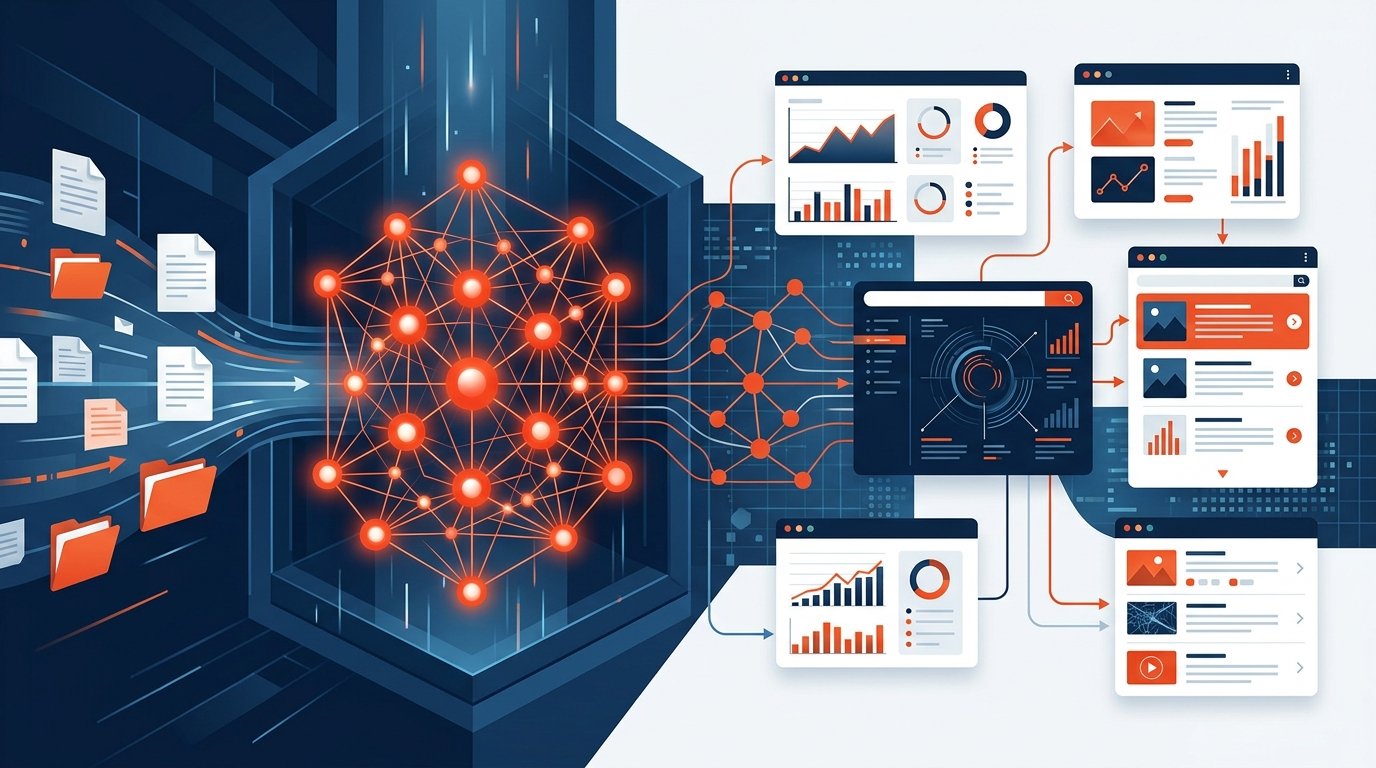
Enterprise RAG is an architecture that combines semantic search in vector databases with natural language generation, allowing models like Claude or GPT-4o to respond with verifiable information from your own sources instead of making up data. In practice, this means the AI doesn’t “know” things from memory: it searches your documents before responding.
The difference from a generic chatbot is fundamental. A conventional chatbot only responds with the model’s general knowledge, does not access internal documents, and can “hallucinate” answers when it lacks information. Enterprise RAG, on the other hand, responds with company-specific information, cites exact sources, and is far more accurate for business use cases. This precision is precisely what makes enterprise RAG such a relevant solution for teams managing complex internal documentation.
Why does it matter now? Because a 20-person SME loses between 40 and 80 hours per week searching for internal documents — between 2 and 4 hours per person per week, according to McKinsey. Enterprise RAG turns that lost time into queries resolved in seconds.
How does intelligent search work under the hood?
Understanding the mechanics of enterprise RAG doesn’t require being a data engineer. The process follows three steps that chain together automatically every time someone asks a question.
Step 1: document indexing and vectorisation
The system first processes all your internal documents — PDFs, wikis, spreadsheets, manuals — and converts them into numerical representations called embeddings. These vectors are organised in a multidimensional mathematical space where semantically close fragments end up nearer to each other. This vector database is the heart of the system.
Dividing documents into appropriately sized fragments — chunking — is essential in any enterprise RAG implementation: if the fragments are too large, the embeddings become too general and do not match user queries well. Getting the fragment size right makes the difference between precise and vague answers. Some advanced pipelines combine vector search with classic BM25 — known as hybrid search — to improve precision in corpora with very specific terminology.
Step 2: semantic retrieval and reranking
When a user submits a query, enterprise RAG converts the question into a vector representation (embedding) and searches the database for the most similar fragments. This search is fast and highly relevant thanks to vector similarity algorithms. In more advanced implementations, a reranking step reorders the retrieved fragments before passing them to the model, improving result relevance without increasing the cost of the initial search.
The key here is that the search is semantic, not literal. If you ask “what are our warranty conditions for the retail sector?”, the system doesn’t look for that exact phrase: it understands the meaning and retrieves relevant fragments even if they use different vocabulary. This is what differentiates the intelligent search of enterprise RAG from a simple Ctrl+F in your folders.
Step 3: generation with verifiable context
With the data retrieved from the knowledge base, the system creates a new prompt for the language model that includes the user’s original query plus the enriched context. The size of that context — the context window — limits how many fragments the model can process at once, which makes chunking and reranking decisive. The result is a natural language response that cites the source document, not an invented answer. In agentic RAG architectures, the system can also chain multiple searches autonomously to answer complex questions that require crossing several sources.
What real problems does it solve in an SME?
Enterprise RAG is not a solution in search of a problem. There are concrete use cases where the return is immediate and measurable.
- Onboarding new employees: new employees consult manuals, regulations, and procedures without interrupting anyone, and the enterprise RAG assistant cites the exact source document.
- Internal customer support: the assistant searches your documentation — PDFs, Confluence, SharePoint, Notion — before responding. Any support agent has the correct answer in seconds.
- Legal and compliance: semantic search over contracts and policies delivers the exact document quote and page number; for companies undergoing certification, having the regulatory corpus queryable via enterprise RAG accelerates audits such as ISO 27001.
- Commercial knowledge management: the sales team can ask “what proposal did we send to the hospitality sector last year?” and get the document in seconds, ready to adapt.
- Development and IT: runbooks, architecture decisions, postmortems, and incident history queryable in natural language. A well-built knowledge graph over this corpus also enables discovery of system dependencies that would otherwise remain buried in scattered documents.
How does RAG differ from fine-tuning?

This is one of the most frequent questions when a company starts exploring AI applied to its internal documents. The confusion is understandable, but the difference is decisive for making the right choice.
Unlike fine-tuning, enterprise RAG updates knowledge in real time without retraining models. This means that when you update an internal procedure, you simply upload the new document to the system and RAG incorporates it immediately. With fine-tuning, you would need to retrain the entire model, which involves cost, time, and advanced technical knowledge.
For the vast majority of SMEs, enterprise RAG is the right choice: lower investment, launch in weeks, and the ability to update knowledge simply by uploading new documents to the system. Fine-tuning makes sense when you need the model to adopt a very specific style or work with highly specialised terminology, but for internal information retrieval, enterprise RAG wins in almost every scenario.
Embedding models: the technical decision that most affects cost and privacy
Choosing the embedding model is as important as choosing the LLM, yet it is the decision most often made by default. The embedding model determines the quality of vectorisation, the cost per indexed document, and — critically — whether data leaves your infrastructure or not.
| Embedding model | Dimensions | Privacy / data residency | Indicative cost | Best for |
|---|---|---|---|---|
| OpenAI text-embedding-3-small | 1,536 | Cloud API; EU residency from Feb. 2025 | ~$0.02 / million tokens | SMEs already using OpenAI that prioritise ease of integration |
| OpenAI text-embedding-3-large | 3,072 | Cloud API; EU residency from Feb. 2025 | ~$0.13 / million tokens | Large corpora where semantic precision is critical |
| Cohere Embed v3 | 1,024 | Cloud API; private deployment option | ~$0.10 / million tokens | Multilingual corpora (Spanish included) and hybrid search |
| nomic-embed-text | 768 | Open source; 100% on-premise | Own compute cost (no licence) | Maximum privacy; teams with their own GPU or dedicated VPS |
| BGE-M3 (BAAI) | 1,024 | Open source; 100% on-premise | Own compute cost (no licence) | Technical or legal corpora in Spanish with specific terminology |
The practical rule is simple: if documents contain personal data, open source on-premise models eliminate the debate about international data transfers. If the corpus is technical or product-related without sensitive data, OpenAI’s text-embedding-3-small offers a quality-to-cost ratio that is hard to beat. For corpora in Spanish with legal or medical terminology, Cohere Embed v3 and BGE-M3 typically outperform OpenAI models in semantic precision.
What tools do you need to implement RAG in your company?
A custom-built enterprise RAG implementation relies on three technology layers. You don’t need to build them from scratch: there are mature solutions for each one.
Vector database
This is where your documents’ embeddings are stored. The most common options for SMEs are Pinecone (managed SaaS, no own infrastructure), Qdrant (open source, can be deployed on-premise for greater privacy), and pgvector. If your company already uses PostgreSQL, you don’t need to contract a new database: just install the pgvector extension and you’re done. For 90% of companies, this is sufficient.
Language model (LLM)
This is the component that generates the natural language response from the retrieved context. GPT and Claude remain the reference models for complex reasoning; their price has dropped dramatically compared to previous years. For companies with strict privacy requirements, open source models such as Meta’s Llama or Mistral have reached a level where they can run enterprise RAG correctly on their own infrastructure.
Orchestration framework
LangChain and LlamaIndex are the most widely used frameworks for connecting all pipeline components — indexing, retrieval, reranking, generation — without having to code each piece from scratch. For teams without developers, platforms like Flowise or n8n allow building RAG flows visually, significantly reducing the technical barrier.
Which enterprise RAG stack fits your profile? Decision tree
Before evaluating tools, answer these three questions in order. Each branch leads to a concrete recommendation and prevents you from spending time analysing options that don’t fit your actual situation.
-
Do you have developers on the team (or budget to hire them)?
- No → Go directly to a no-code SaaS platform: Guru if you need human-verified knowledge, Vectara if you prioritise hallucination control via API without code. Both have connectors for Google Workspace and Microsoft 365.
- Yes → Move to question 2.
-
Does the corpus contain personal data (contracts, files, records)?
- Yes → You need an on-premise or private cloud architecture. Recommended stack: pgvector + LangChain + Llama/Mistral on your own VPS or server. Embedding model: nomic-embed-text or BGE-M3. Zero data leaves your infrastructure.
- No → Move to question 3.
-
Does the corpus exceed 5,000 documents or do you need to connect more than five different sources?
- Yes → Consider Glean (native connectors for 100+ apps, permission inheritance included) or a custom stack with Qdrant + LlamaIndex for greater control.
- No → A pilot with pgvector + LangChain + OpenAI text-embedding-3-small + GPT-4o mini is sufficient to validate the concept. API cost: under €50 per month in the pilot phase.
SaaS RAG platforms: when to buy instead of build
Not all SMEs have the technical capacity to build a RAG pipeline from scratch. For them, SaaS RAG platforms are the fastest route to production: connect your data sources, configure permissions, and start querying, without managing infrastructure. Buying makes sense when RAG is an internal capability for the team: connectors, permission inheritance, audit logs, and SSO integration are non-trivial components to build and even harder to maintain.
| Platform | Ideal profile | Privacy / EU data | Ease of deployment | Indicative price |
|---|---|---|---|---|
| Glean | Mid-to-large companies with many apps (Slack, Drive, Jira, Confluence…) | Cloud; review DPA for GDPR | High — native connectors for 100+ apps | Custom quote (enterprise) |
| Guru | Teams that need human-verified and curated knowledge | Cloud; SOC 2; check residency | High — no-code interface, verification every 90 days | From ~$10/user/month (Starter plan) |
| Vectara | Technical teams wanting RAG-as-a-Service via API with hallucination control | Cloud SaaS; review DPA | Medium — requires API integration | Free plan + pay-as-you-go paid plans |
| Flowise / n8n | SMEs with some technical profile wanting to build RAG flows visually | Self-hosted available (maximum control) | Medium-high — visual interface, no code | Open source; cloud from ~$35/month |
| Custom stack (pgvector + LangChain + LLM API) | Teams with developers needing full pipeline control | On-premise or own cloud | Low — requires development | API cost + team time |
For teams that want RAG without infrastructure management, Vectara and Glean are the fastest paths to production: upload documents, start querying, no pipeline engineering. Guru, for its part, requires internal experts to review and re-approve knowledge cards on a fixed cycle — typically every 90 days; if a card expires without verification, the AI agent cannot use it, resulting in a verified RAG based only on reliable and up-to-date content. Both Guru and Glean have native connectors for Google Workspace and Microsoft 365, the two most common ecosystems in SMEs, eliminating the need for manual integration work.
GDPR and EU data residency: the barrier nobody mentions

For an SME, the question of privacy is not optional: it is a real adoption barrier. When an enterprise RAG system processes documents containing personal data — client contracts, employee records, support histories — it falls within the scope of the GDPR and, since 2024, also the EU AI Act.
The Spanish Data Protection Agency (AEPD) published its guide on the use of artificial intelligence and data protection in 2024, reminding that any system that processes personal data — including fragments sent to an LLM — must have a legal basis, a record of processing activities, and, where applicable, a data protection impact assessment (DPIA). ENISA, for its part, noted in its AI threat report that data exfiltration through third-party APIs is one of the most underestimated risk vectors in generative AI deployments at European companies.
In practice, there are three architectural decisions that determine your level of risk:
- On-premise or private cloud: your documents never leave your infrastructure. This is the safest option for highly sensitive data and eliminates the debate about international transfers. Open source models like Llama or Mistral make this viable without licence costs.
- LLM API with EU residency: EU data residency for OpenAI arrived for data at rest in February 2025 and was extended to inference within the European region in January 2026, although granularity is regional, not by specific country. Microsoft Copilot keeps data within the EU Data Boundary. In both cases, you must sign a DPA (data processing agreement) with the provider before indexing any document containing personal data.
- SaaS RAG platforms: always check whether they offer a DPA, in which region data resides, and whether they hold certifications such as SOC 2 or ISO 27001. No solution is GDPR-compliant on its own; the company remains the data controller under Article 24 of Regulation (EU) 2016/679.
The practical recommendation: before indexing any document, classify the corpus according to whether it contains personal data. Purely technical or product documents can go to a cloud solution without issue; employee records or client contracts deserve an on-premise architecture or, at minimum, a provider with a signed DPA and verified EU residency.
How to implement RAG step by step in an SME?
Implementing enterprise RAG in an SME follows a logical sequence that moves from the simplest to the most complex. Here is the practical roadmap.
- Document audit: identify which knowledge bases exist (Drive, SharePoint, Notion, local PDFs), what state they are in, and which generate the most repetitive queries. The quality of the corpus determines the quality of enterprise RAG.
- Pilot use case definition: choose a single department or process — for example, onboarding new employees or support team FAQs — with relatively well-organised documentation.
- Technology stack selection: for an enterprise RAG pilot in an SME, a combination such as pgvector + LangChain + OpenAI or Claude API is sufficient to validate the concept without over-engineering. If there is no technical team, consider a SaaS platform like Guru or Vectara.
- Indexing and chunking: process the documents, divide them into coherent fragments, and generate the embeddings. Knowledge bases must be continuously updated to maintain the quality and relevance of the system.
- Query pipeline construction: configure the complete flow: question intake → semantic search (or hybrid search) → reranking → fragment retrieval → response generation with source citation.
- Evaluation and metrics: see the specific section below.
- Deployment and governance: an enterprise RAG architecture must address security, permissions, traceability, and data governance. Define who accesses which documents and how queries are audited.
Production system maintenance: the lifecycle nobody explains
Deploying the pilot is only half the work. An enterprise RAG system in production degrades if not actively maintained, because documents change, models are updated, and the corpus grows in a disorganised way.
These are the four processes you must have covered from day one:
- Document versioning and reindexing: when an internal procedure changes, the old document must be marked as obsolete and the new one must be reindexed immediately. If you don’t have this process automated, the system will start responding with outdated information without anyone noticing. Tools like LlamaIndex allow configuring incremental reindexing so that only modified documents are processed, not the entire corpus.
- Obsolescence management: establish an expiry policy for each document type. A product manual may have a six-month validity; an internal HR policy, one year. Guru handles this with its 90-day verification cycle; in custom stacks, you need to implement it yourself.
- Corpus drift monitoring: when the document volume grows significantly, the semantic distribution of the corpus changes and embeddings generated months ago may lose precision. A monthly sample of 20–30 reference queries detects these drifts before they impact users.
- Model updates: when the provider releases a new version of the embedding model or LLM, evaluate whether it is worth reindexing the entire corpus. Switching from text-embedding-3-small to text-embedding-3-large, for example, requires regenerating all vectors; the cost is low, but the process must be planned.
How to measure whether your enterprise RAG is working well: metrics and evaluation
“The system responds” is not enough. An enterprise RAG system in production needs concrete metrics to detect degradations before users notice them.
The four key metrics of the RAGAS framework
Imagine your RAG system is a researcher looking up information for you. RAGAS measures two things: whether the researcher found the right documents (retrieval) and whether they then faithfully reported what they found (generation). If it fails on the first, the answer will be incomplete; if it fails on the second, the answer will be fabricated even if the documents were correct.
- Faithfulness: measures whether each claim in the response is supported by the retrieved fragments. Think of it as the percentage of sentences in the response that you can underline in the source documents. A threshold of 0.85 is the standard in production; if the weekly average drops more than 5%, investigate.
- Context Precision: proportion of retrieved fragments that are genuinely relevant to the question. A low value indicates that reranking or chunking needs adjustment.
- Context Recall: proportion of the knowledge needed to answer that the system has managed to retrieve. A low value indicates that the corpus is incomplete or poorly indexed.
- Answer Relevancy: measures whether the generated response is pertinent to the original question, regardless of whether it is faithful to the context.
Typical reference thresholds in production are: faithfulness 0.75, answer relevancy 0.80, context precision 0.70, context recall 0.80. Faithfulness is the metric that separates a hallucination-prone system from a reliable one: all the others exist to keep it at acceptable levels.
Evaluation tools
RAGAS provides the conceptual framework; DeepEval adds CI/CD integration; Patronus, Langfuse, and Lynx cover specific gaps in hallucination detection, production traceability, and bias evaluation. For teams just starting out, RAGAS or DeepEval are the best option for volumes of up to ~2,000 weekly evaluations if you already use Grafana or Datadog.
The recommended cadence: a set of 50–100 reference questions with expected answers run on every pipeline change, plus a 1% sample of real production traffic to detect silent degradations from corpus or model drift.
What are the most common mistakes when implementing RAG?
Knowing common mistakes before you start saves time and money. These are the ones that appear most regularly in enterprise RAG projects.
- Disorganised or outdated corpus: enterprise RAG amplifies the quality of your documents, it doesn’t fix it. If manuals have three contradictory versions, the system will return contradictory answers. Before indexing, clean and version your documents.
- Ignoring chunking: poor document fragmentation is the most common cause of imprecise answers. A fragment that is too small loses context; one that is too large saturates the model’s context window.
- Neglecting latency: the retrieval step prior to generation can increase response time; to mitigate this, optimise indexing and the search engine, and implement smart caches that reduce repetitive queries.
- Not defining permissions from the start: in an SME, not all employees should access all documents. Designing access control after the fact is far more costly than including it from day one.
- Not measuring: deploying without evaluation metrics (faithfulness, context precision) is a blind bet. Hallucinations don’t disappear with RAG: a Stanford study on RAG legal systems in production found non-trivial hallucination rates even in leading commercial platforms; they were still better than a base LLM alone, but they were not infallible.
- Trying to cover everything at once: a scoped pilot with clear metrics is more valuable than a global deployment without success criteria.
How much does it cost to implement enterprise RAG in an SME?
The cost varies depending on scope, the chosen stack, and whether development is outsourced or done internally. However, there are useful indicative ranges for planning.
For an SME, an enterprise RAG pilot in the initial phase has a development cost of between €6,000 and €15,000 if outsourced, plus language model API costs, which at this stage are almost negligible — tens of euros per month. From there, scalability depends on document volume and the number of concurrent users.
For teams with internal technical capacity, the cost of enterprise RAG can be significantly reduced using open source tools and local models. The real investment in that case is team time, not software licences. In any scenario, the return is measured in recovered hours: if a ten-person team stops losing two hours per week searching for documents, the annual saving far exceeds the pilot investment.
Frequently asked questions about enterprise RAG
Do I need a data science team to implement RAG in my company?
Not necessarily. For a basic enterprise RAG pilot, a developer with Python knowledge and familiarity with APIs can build a functional RAG pipeline using frameworks like LangChain or LlamaIndex. For companies without their own technical team, there are no-code platforms like Flowise or specialised SaaS solutions like Guru or Vectara that lower the barrier to entry. The key is to start with a scoped use case and a clean corpus.
Will my internal documents be safe if I implement RAG?
Security depends on the chosen architecture. If you opt for an on-premise solution or your own private cloud, your documents never leave your infrastructure. If you use external language model APIs, text fragments are sent to the provider to generate the response, so you must review their privacy policies, sign a DPA, and verify EU data residency. For highly sensitive information, local open source models are the safest option from a GDPR perspective.
What types of documents can a RAG system index?
A well-configured enterprise RAG system can index virtually any textual format: PDFs, Word documents, Notion or Confluence pages, spreadsheets, emails, meeting transcripts, internal web pages, and structured databases. The condition is that the content is extractable as text. Scanned documents without OCR or images without alternative text require a prior processing step.
How long does it take to implement a RAG pilot?
A well-scoped enterprise RAG pilot — a single department, a corpus of fewer than 500 documents, a defined use case — can be operational in four to eight weeks. The actual time depends mainly on the state of the source documentation: if documents are organised and up to date, indexing is fast; if the corpus needs cleaning and versioning first, the timeline extends. The subsequent evaluation and adjustment phase typically requires an additional two to three weeks.
What is hybrid search and when should it be used in RAG?
Hybrid search combines vector search (semantic) with BM25 search (classic lexical) to improve retrieval in corpora with very specific terminology — product names, internal codes, acronyms — where purely semantic search may fail. It is especially useful in legal, technical, or compliance environments where exact terms matter as much as meaning. Most modern frameworks (LangChain, LlamaIndex, Haystack) support it natively.