Amara, ingeniería de marketing

Customer Segmentation: Criteria, Methods and Effective Segments

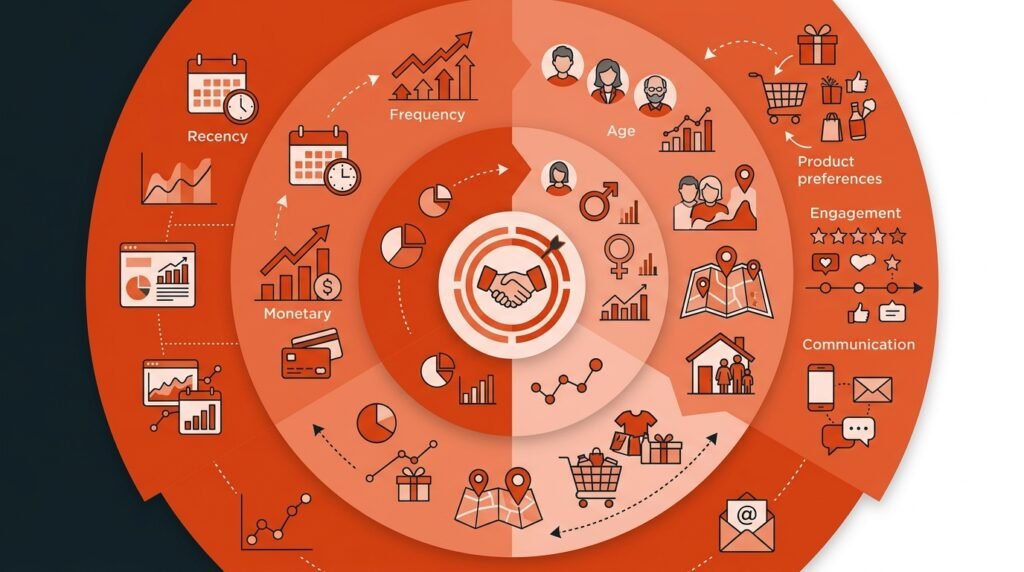
Capas de segmentación de clientes representadas con círculos concéntricos y códigos visuales para diferentes criterios de

Customer segmentation is one of the pillars of modern marketing. It consists of dividing your customer base into homogeneous groups to address each one with messages, offers and channels tailored to their real needs. Without customer segmentation, any campaign risks being too generic to be effective. According to Salesforce’s State of Marketing report, 84% of customers expect to be treated as a person, not a number; and high-performing marketing teams are 2.4 times more likely to personalize their communications at scale. McKinsey estimates that personalization based on segmentation can reduce acquisition costs by up to 50% and increase revenue by between 5% and 15%.

What is customer segmentation and why does it matter?

Segmenting means grouping people with similar characteristics or behaviors within a broader market. The goal of customer segmentation is not to classify for the sake of classifying, but to identify patterns that allow you to personalize your marketing and sales strategy.

When you know each segment well, you can adjust the message, the channel and the moment of contact. The result is more relevant communication, a higher conversion rate and a better customer experience. Companies that implement effective customer segmentation can reduce acquisition costs by focusing resources on audiences with a higher probability of conversion. In short, segmentation turns data into decisions and opens the door to dynamic personalization.

What are the main segmentation criteria?

There are four major blocks of criteria that you can combine according to your business and the available data to carry out effective customer segmentation.

Demographic criteria

These are the most commonly used as a starting point in any customer segmentation process. They include variables such as age, gender, income level, educational level or family situation. Demographic criteria are easy to obtain and allow you to build basic profiles quickly.

For example, a management software brand can segment by company size and decision-maker role, differentiating between the freelancer who needs simplicity and the financial director of an SME who prioritizes integrations.

Geographic criteria

Location remains a relevant criterion in customer segmentation, especially for businesses with a local presence or with offers that vary by region. You can segment by country, region, city or even by population density.

An ecommerce store, for example, can adapt its promotions according to the seasonal climate of each geographic area.

Psychographic criteria

This includes the values, lifestyle, interests and personality of the customer. This type of customer segmentation is harder to measure than demographic segmentation, but offers a deeper understanding of purchase motivations and the complete customer journey.

A healthy food brand, for example, does not address someone who practices competitive sport in the same way as someone who is looking to improve their diet on medical advice.

Behavioral criteria

Purchase behavior is one of the most valuable criteria in customer segmentation. It analyzes how customers interact with your brand: purchase frequency, average ticket, preferred channels, response to promotions or the customer lifecycle stage.

This type of segmentation makes it possible to identify, for example, high-value customers who buy frequently but never open your emails, and to design a specific strategy to reactivate them through another channel. It is also the basis for measuring purchase propensity and detecting potential churn rate.

B2B vs. B2C segmentation: key differences

Customer segmentation does not work the same way in all markets. When you sell to businesses (B2B), the criteria and the decision-making process change substantially compared to when you sell to end consumers (B2C).

B2B segmentation

In B2B environments, the most relevant criteria for customer segmentation are usually the industry sector, company size, the contact’s role and the stage of the buying process. The sales cycle is longer, several decision-makers are involved and purchase propensity depends on both rational factors and the relationship with the supplier.

A typical example: segmenting by annual revenue and number of employees to differentiate between SMEs that need a turnkey solution and large accounts that require integration with their existing systems. In B2B, lead scoring is the mechanism that translates customer segmentation into commercial prioritization.

B2C segmentation

In B2C environments, behavioral and psychographic criteria carry more weight in customer segmentation. The volume of customers is higher, decisions are faster and microsegmentation allows communication to be refined at a low marginal cost.

A fashion retailer, for example, can segment by browsing history, categories viewed and purchase frequency to launch hyperpersonalized reactivation campaigns. Lookalike audiences extend this logic: starting from a high-value customer segment, advertising platforms identify new profiles with analogous behaviors.

Customer lifecycle segmentation

One of the most powerful applications of customer segmentation is classifying users according to the stage of their relationship with the brand. The customer lifecycle defines what each person needs at each moment, and allows you to design radically different actions for groups that, in demographic terms, would be identical.

New customer

They have made their first purchase in the last 30–60 days. The priority objective is to turn that first transaction into a habit: the second purchase is the most predictive indicator of long-term retention, according to Bain & Company studies. The recommended action is an onboarding sequence that educates about the product and facilitates the second conversion with a low-cost incentive.

Active customer

They buy regularly within the expected frequency window for your category. The risk here is complacency: assuming they will keep buying without stimulation. The recommended actions are loyalty programs, cross-selling and upselling based on purchase history.

At-risk customer

Their purchase frequency has fallen below the segment average or more time than usual has passed since their last transaction. Detecting this stage before the customer leaves is the greatest return of behavioral segmentation: intervening at risk costs between 5 and 25 times less than recovering an already lost customer (Harvard Business Review). The recommended action is a proactive retention campaign.

Inactive customer

They have not purchased in a period significantly longer than their historical frequency. In ecommerce, this is usually set at between 6 and 12 months. Not all inactive customers deserve the same recovery effort: prioritize those who had a high LTV before becoming inactive. The recommended action is a win-back campaign with a clear incentive.

Recovered customer

They have purchased again after a period of inactivity. This is the most fragile segment: they have a higher probability of becoming inactive again than a customer who never left. The recommended action is to treat them like a new customer: a reactivation sequence and close follow-up in the first 60 days.

Stage Classification criterion Warning signal Recommended action
New First purchase in the last 30–60 days No second purchase after 45 days Onboarding sequence + second purchase incentive
Active Frequency within the expected window Drop in average ticket Cross-sell, upsell, loyalty program
At risk Frequency below segment average Time without purchase exceeds historical average Proactive retention campaign, NPS survey
Inactive No purchase in 6–12 months (depending on sector) No email opens in 90 days Win-back with incentive; if no response, suppress
Recovered Purchase after a period of inactivity Second inactivity in the first 60 days Treatment as a new customer + close follow-up

What methods exist for creating segments?

Once the customer segmentation criteria are defined, you need a method to build the segments systematically. The most common are:

  • A priori segmentation: you define the groups before analyzing the data, based on known criteria. It is quick and easy to implement, although it can be imprecise.
  • Cluster-based segmentation: you use statistical or machine learning techniques to let the data reveal natural groupings. It is more complex, but produces segments that are more aligned with reality.
  • RFM segmentation: classifies customers according to Recency, Frequency and Monetary Value. It is especially useful in ecommerce and retail.
  • Predictive segmentation: applies machine learning models to behavioral history to anticipate which customers are most likely to buy, to churn or to respond to a specific offer.
  • Buyer personas: semi-fictional representations of ideal customers, built from real data and interviews. They complement quantitative segmentation with a qualitative dimension and are the natural bridge to content strategy.
Method Complexity Data required Ideal use case
A priori Low Basic variables (age, sector, geography) First segmentations or limited resources
Clusters High Behavioral history and multiple attributes Large databases with non-obvious patterns
RFM Medium Transaction history Ecommerce, retail and subscriptions
Predictive High Historical behavior + contextual signals Reduce churn, prioritize leads, dynamic personalization
Buyer personas Medium Interviews, surveys and qualitative data Content strategy and brand positioning

Real use case: RFM segmentation in a fashion ecommerce store

This is a representative case — based on common patterns in customer segmentation projects for fashion ecommerce stores with databases of between 50,000 and 150,000 records — that illustrates the real impact of moving from mass communication to RFM segmentation.

Starting situation: a fashion ecommerce store with 80,000 active customers was sending the same weekly newsletter to the entire database. The average open rate was 18% and the conversion rate on sends was 1.2%.

Intervention: an RFM model was applied to classify the database into five operational segments: champions, at-risk loyals, occasional buyers, recent inactives and deep inactives. Each segment received a different communication sequence.

Results after 90 days:

  • The average open rate rose from 18% to 29% (+61% relative).
  • The conversion rate on sends went from 1.2% to 2.7% (+125% relative).
  • The average LTV of the champions segment grew by 22% in the quarter.
  • The cost per new customer acquisition fell to €27 (–29%).

The key was not the technology, but the discipline of not sending the same message to everyone. Customer segmentation does not require artificial intelligence to generate results: it requires clear criteria, clean data and the willingness to execute in a differentiated way.

Tools for implementing customer segmentation

Segmentation tools dashboard with customer data transformed into visually differentiated groups by color.
Modern segmentation platforms automate the classification of raw data into cohesive clusters, reducing manual time and improving accuracy in identifying behavioral patterns.

Knowing the methods is only half the work. The other half is executing customer segmentation with the right tools:

  • HubSpot: ideal for customer segmentation in B2B environments. It allows you to create dynamic lists based on contact properties, website behavior and lifecycle stage.
  • Klaviyo: a reference in ecommerce for RFM segmentation and campaign automation. It connects directly with platforms like Shopify and enables very granular customer segmentation based on purchase history.
  • Google Analytics 4: useful for customer segmentation based on website behavior. Its predictive audiences incorporate purchase propensity signals.
  • Segment or Amplitude: customer data platforms (CDP) that centralize behavioral events from multiple sources and allow you to build very precise microsegmentation segments.

How to choose the right tool for your context

The right choice depends on three specific variables. Choosing the wrong tool is not a technical problem: it is a problem of resources and team adoption.

Variable Recommended tool Why
Low budget (< €200/month) + ecommerce Klaviyo (basic plan) Native RFM, direct integration with Shopify/WooCommerce, low learning curve
Medium budget + B2B with CRM HubSpot (Starter or Pro) Segmentation + lead scoring + automation in a single platform
Large database (> 200k records) + multiple channels Segment or Amplitude CDP that centralizes heterogeneous sources and allows segments to be activated on any channel
Zero budget + initial analysis Google Analytics 4 Free predictive audiences, direct export to Google Ads
High data maturity + predictive models Amplitude + custom model (Python/R) Maximum flexibility for personalized predictive segmentation

The most important criterion is not the budget or the size of the database: it is the integration with the CRM or ecommerce platform you already use. A perfect tool that does not connect with your existing data produces segments in a silo that no one activates.

How to implement customer segmentation step by step

Knowing what customer segmentation is and understanding its methods is not enough: the real value lies in executing it in an orderly way. This is the process we follow at Amara when we help a business segment from scratch.

  1. Define the business objective. Before touching any data, answer: why do you want to segment? The objective determines which criteria and which method are relevant to your customer segmentation.
  2. Collect and audit the available data. Take stock of what data you have and evaluate its quality and coverage. A segment is only as good as the data that supports it. Without reliable data, any customer classification lacks a solid foundation.
  3. Choose the criteria and the method. With the objective and the data on the table, select the criteria and the method. For a first segmentation with limited data, start with RFM or a priori.
  4. Build and name the segments. Apply the chosen method and generate the groups. Give them operational names that the team understands immediately. Verify that each group meets the four conditions: measurable, accessible, substantial and actionable.
  5. Validate the segments before activating them. Check that the groups have internal coherence and review their size. Verify with the sales team whether the profiles make sense in practice.
  6. Activate the segments in campaigns and measure. Translate each segment into concrete actions and monitor the key metrics by segment. Schedule a quarterly review to detect segments that have lost homogeneity.

Common mistakes in customer segmentation

Customer segmentation fails more due to execution errors than due to a lack of data. These are the three most common mistakes:

Over-segmenting

Creating too many segments in the hope of achieving maximum precision. The result is the opposite: the team does not have the capacity to execute differentiated strategies for each group. Start with three or four well-defined segments and add granularity only when you have the operational capacity to manage it.

Not updating the segments

Customer behavior changes: a VIP customer from two years ago may have reduced their purchase frequency and be at risk of churning. If you do not review the segments regularly — at least every quarter — your campaigns will continue to target groups that no longer exist. Customer segmentation is a continuous process, not a one-off project.

Using criteria without sufficient data

Segmenting by a criterion when only 5% of your database has that data produces a statistically irrelevant segment. Each criterion must be backed by data with sufficient coverage. If you do not have it, first use behavioral or demographic criteria that you can measure reliably.

Customer segmentation and GDPR: privacy by design

Customer segmentation based on personal data has direct legal implications in the UK and throughout the European Union. Ignoring them is not an option: lack of consent can constitute a serious or very serious infringement depending on each case.

The key points you need to keep in mind:

  • Legal basis for processing. The European Union’s legal requirement is informed consent for appropriate use of data, as established by the GDPR. You cannot use behavioral data for segmentation if the user has not expressly accepted that purpose.
  • Specific purpose and limitation. You cannot use data collected to process an order to build a purchase behavior profile without additional consent.
  • Behavioral segmentation and advanced profiling. Advanced profiling requires a valid legal basis, which in most cases is consent. Personalizing communications based on user behavior is only legal if the user has expressly accepted that specific purpose.
  • Tools and suppliers. All tools that process personal data require a Data Processing Agreement. The company is responsible for ensuring that its suppliers comply with the regulations.

Respecting GDPR requirements is not only a legal obligation, but also an opportunity to build more transparent relationships. Customer segmentation built on data with explicit consent produces more reliable segments and more receptive audiences.

How to create truly effective segments?

Linear process of creating effective segments: from raw data to validated and actionable buyer personas.
An effective segment requires validation: it must be measurable (quantifiable size and characteristics), accessible (reachable with your channels) and profitable (with potential to respond to differentiated marketing actions).

Creating a segment within your customer segmentation strategy is not just about grouping people: it is about building a category that makes strategic sense. For a segment to be effective, it must meet four conditions:

  • Measurable: you must be able to quantify its size and characteristics with the data you have.
  • Accessible: you must be able to reach that group through specific channels.
  • Substantial: it must be large enough to justify a differentiated strategy.
  • Actionable: you must be able to design specific actions for that segment that are different from those for the rest.

In addition, review your segments regularly. Customer purchase behavior changes, and a segment that was relevant a year ago may have lost coherence. Customer segmentation is not a one-off exercise, but a continuous process.

Metrics for evaluating the performance of your segments

Defining segments is the starting point; measuring their performance is what closes the strategic cycle of customer segmentation. Once you activate your campaigns by segment, these are the metrics you should monitor:

Conversion rate by segment

Compare how many customers in each group complete the desired action. Differences between segments reveal which groups respond best to your current messages and which ones need adjustment. A variation of more than 50% between the highest and lowest converting segment indicates that the segmentation is working.

Lifetime Value (LTV) by segment

The total value a customer contributes during their relationship with the brand. Customer segmentation by LTV allows you to prioritize resources in the most profitable groups and design differentiated retention strategies. According to Forrester Research, companies that actively segment by LTV generate between 10% and 30% more recurring revenue.

Churn rate by segment

The abandonment rate broken down by group is one of the earliest signals that a segment has lost relevance. Crossing it with RFM allows you to anticipate customer loss before it happens, rather than reacting when it is already too late. Monitoring this metric is especially critical in any customer segmentation strategy focused on retention.

Reactivation rate

Measures what percentage of inactive customers in a segment responds to your recovery campaigns. A reactivation rate below 5% in win-back campaigns usually indicates that the inactive segment is too cold and that it is advisable to suppress those records from regular communications.

Open rate and click rate by segment

In email campaigns, these metrics indicate whether the message resonates with each group. A low open rate in a specific segment usually signals a relevance problem, not a volume problem.

Reviewing these metrics periodically — at least every quarter — allows you to detect when a segment has lost homogeneity and needs to be redefined. A well-maintained customer segmentation improves progressively with each review cycle.

How to apply segmentation to your marketing campaigns?

Customer segmentation gains real value when it is translated into concrete actions. Once you have your segments defined, you can apply personalization at several levels:

  • Messages and creatives: adapt the copy, images and tone according to the motivations of each segment.
  • Distribution channels: some segments prefer email; others respond better to social media or organic search.
  • Offers and prices: design specific promotions for high-value customers or to recover inactive customers.
  • Educational content: if a segment is in the consideration stage of the customer journey, it needs different information from someone who is ready to buy.
  • Lookalike audiences: use your highest-LTV segments as a seed to identify new potential customers with analogous profiles on advertising platforms.

For example, if your RFM analysis identifies a group of customers who purchased more than six months ago and have not returned, you can launch a reactivation campaign with a specific incentive, rather than including them in your general communication. Customer segmentation allows you to make this kind of decision with criteria and without wasting budget.

Customer segmentation, well executed, not only improves the performance of your campaigns: it also reduces spending on poorly qualified audiences and strengthens the relationship with each type of customer. It is, in short, the foundation on which to build a truly differentiated marketing strategy.

Frequently asked questions

How many segments should I have as a starting point?

It is advisable to start with three or four well-defined segments. Too many segments make execution difficult and dilute the team’s resources. As you gain operational capacity and performance data, you can add granularity progressively.

How often should I review and update my segments?

At least every quarter. Customer purchase behavior changes, and a segment that was relevant a year ago may have lost coherence. A segment that does not improve any metric compared to general communication does not justify the personalization effort and should be redefined.

What is the difference between RFM segmentation and predictive segmentation?

RFM segmentation classifies customers according to their past behavior (Recency, Frequency, Monetary Value) and is reactive: it describes what has already happened. Predictive segmentation applies machine learning models to anticipate future behaviors — purchase probability, churn risk, response to an offer — incorporating contextual signals that RFM does not capture. Both methods are complementary within a customer segmentation strategy.

Can I use web behavioral data for segmentation without violating GDPR?

Yes, but with conditions. Advanced profiling based on behavior requires a valid legal basis, which in most cases is the user’s explicit consent for that specific purpose. If the user only accepted basic analytics cookies, you cannot use that data to build behavioral segments for commercial purposes without additional specific consent.

What is lead scoring and how does it relate to segmentation?

Lead scoring is a scoring system that assigns each contact a rating based on their fit with the ideal profile (demographic or firmographic data) and their level of activity (behavior). It is the operational translation of customer segmentation in B2B environments: it converts segments into a prioritized list for the sales team, from highest to lowest probability of conversion.

Sources