
Storytelling is, in essence, the art of telling stories with a strategic purpose. In a business context, it is not about inventing fictional tales, but about building authentic narratives that connect your brand with the people you want to reach. If you have ever felt that your marketing messages sound like a product catalogue, storytelling is the tool you need to change that perception.
Contenidos

What is business storytelling
Business storytelling is the practice of communicating a company’s values, value proposition and identity through structured stories. Instead of listing product features, a story places the customer in a recognisable scenario, presents a real problem and shows how the brand helps to solve it.
Corporate storytelling has moved beyond being a marketing tactic to become a fundamental strategic competence: it is the art and science of building stories that not only inform, but inspire, connect and mobilise. It is not advertising disguised as a tale; it is honest communication with a narrative structure.
The difference from traditional marketing is clear: while a conventional advertisement describes what you sell, storytelling shows why it matters. And that difference, in a market saturated with messages, is decisive.
Why storytelling works in marketing
Stories activate cognitive and emotional mechanisms that rational arguments cannot achieve on their own. When we hear a well-constructed story, our brain does not simply process information: it experiences it. This generates memory, empathy and, ultimately, trust.
There is solid evidence behind this mechanism. A study by Professor Chip Heath of Stanford University showed that after listening to presentations that combined stories and data, 63% of participants remembered the stories, while only 5% were able to recall an isolated statistic. In other words: data informs, but stories stick.
Furthermore, according to the Stanford Graduate School of Business, stories are remembered up to 22 times more than isolated facts. For an entrepreneur or a marketing director, this has a very concrete translation: less effort to persuade, more ease in being remembered.
The four key elements of a good brand story
Not every narrative is effective storytelling. A brand story that works combines four fundamental elements that work together to create impact:
Character
Every story needs a protagonist with whom the audience can identify. In business storytelling, that character is usually the customer, not the brand. The company acts as a guide or facilitator, not as the hero. This shift in perspective is one of the most common mistakes brands make: talking about themselves when they should be talking about those who use them.
A concrete example: Nike does not sell trainers, it tells stories of personal overcoming. Its Just Do It campaign speaks directly to the consumer’s emotions, conveying that, regardless of circumstances, you can achieve what you set out to do. The protagonist is not Nike; it is the athlete — or the ordinary person — who surpasses their own limits. The brand appears as a companion on the journey.
Conflict
Without tension there is no story. Conflict is the problem, the friction or the challenge that the character needs to overcome. In marketing, this conflict must match exactly the pain that your product or service resolves. A narrative that does not anchor the conflict in the reader’s reality generates no tension, and without tension, there is no story.
Airbnb, instead of talking about prices or amenities, has told stories of travellers who found a home away from home, building a narrative around the idea of belonging. The conflict is universal: the loneliness and rootlessness of travelling. The platform appears as the natural solution, not as an advertisement.
Transformation
Transformation is the emotional heart of any story. The character enters with a problem and leaves having changed something: their situation, their knowledge or their perspective. In the context of brand stories, that transformation must be credible and specific. Not “their life improved”, but “they halved their management time and were able to dedicate those hours to their family”.
Apple’s Shot on iPhone campaign turned its users into narrators, showcasing real photos and videos taken with their devices. The transformation is visible: any person can capture extraordinary moments. The product is not advertised; it is demonstrated through the real experience of those who use it.
Message
Every story must convey a clear message, aligned with the brand’s values. This message does not have to be explicit; in fact, the best stories leave it implicit and allow the reader to discover it for themselves. That generates a sense of complicity that no slogan can replicate.
Apple, with Think Different, did not talk about technical specifications but about the mindset of those who use its products: innovators, creatives, people who dare to dream big. The message — “we are for those who change the world” — is never stated literally. And that is why it works.
How an effective business story is structured
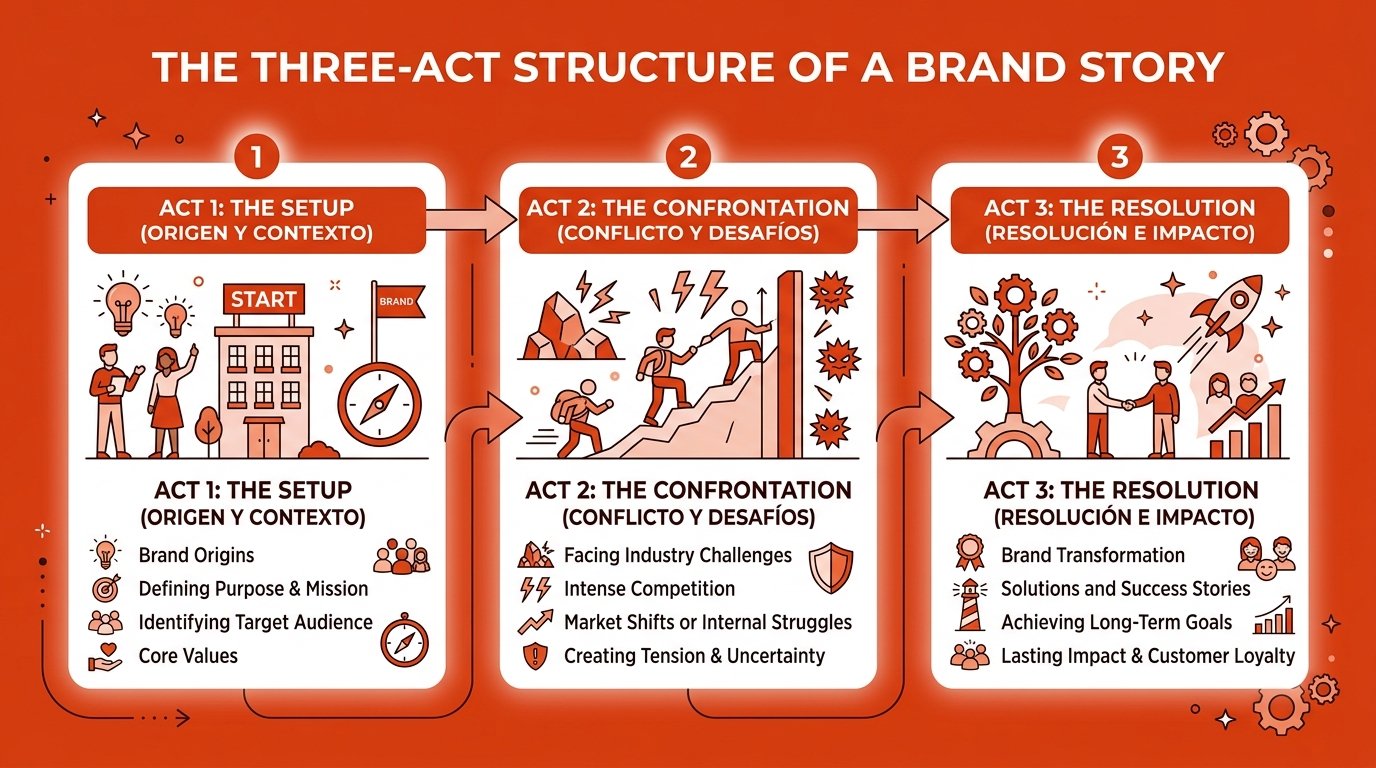
There are several narrative structures you can apply to business storytelling. The most versatile and proven is the one that follows the classic three-act arc:
- Initial situation: introduces the character in their usual context. The reader must recognise that reality as their own.
- Conflict or trigger: something changes, a problem or opportunity appears that forces the character to act.
- Resolution and transformation: the character overcomes the obstacle — with or without the help of your brand — and reaches a better state. This is where your value proposition fits in naturally.
This structure is the foundation, but you can enrich it with additional narrative devices. Suspense keeps the audience in suspense until the outcome. The emotional climax — that peak moment that makes the story unforgettable — can be dramatic, funny or moving, but it must be something that stays in your audience’s memory.
Narrative canvas: a template to apply today
Before writing any piece of content, complete this four-question canvas. If you cannot answer all four, you still have a catalogue, not a story:
- Who is the protagonist? Define your ideal customer with a name, context and specific situation. The more specific, the better.
- What is their conflict? What problem did they have before meeting you. What prevented them from solving it on their own.
- What changed? Describe the transformation in tangible terms: what can they do now that they could not before.
- What does this say about your brand? Extract the implicit message that connects the story with your values or value proposition.
This canvas works for any format: a LinkedIn post, a welcome email, the “About Us” page of your website or a commercial presentation. The story changes in length and tone depending on the channel; the structure does not.
Where to apply storytelling in your marketing strategy
Storytelling is not a format; it is a way of thinking about communication. That is why it can — and should — be applied across multiple channels and formats:
Website and “About Us” page
The “About Us” page is the most underused place for business storytelling. Instead of a list of years of experience and corporate values, tell the origin story of the company: what problem you saw, why you decided to solve it and what you learned along the way. Brand narratives help companies clarify their values with a consistent voice at every customer touchpoint.
Social media and organic content
On social media, storytelling works especially well in the format of a success story, testimonial or customer story. One of the keys is to focus on the brand’s values, not just the products: a post about the manufacturing process can connect more than one about technical specifications.
Furthermore, story-based content tends to generate greater participation — comments, shares and reactions — which translates into greater organic reach and visibility.
Video storytelling: Reels, YouTube and brand spots
Video is today the fastest-growing narrative format. According to HubSpot’s State of Marketing 2025 report, short-form video — Reels, YouTube Shorts, TikTok — is the type of content in which the most marketers plan to invest in 2025. And it is no coincidence: video storytelling gives brands an effective way to stand out by sharing genuine stories that highlight their human side.
GoPro is the greatest example of storytelling built from user-generated content: it builds its brand narrative with the stories that its own customers capture with their cameras. The result is a community that produces authentic content continuously, at no production cost to the brand. YouTube, for its part, gives brands the freedom to tell the stories they want to tell regardless of format or length, making it the ideal channel for more elaborate narratives.
In practice, adapting storytelling to video means thinking in three simultaneous layers: what is seen (image), what is heard (music, voice, silence) and what is felt (rhythm, tension, resolution). Brands that master these three layers build pieces that are remembered long after the screen goes dark.
Email marketing and nurturing sequences
Email is one of the channels where storytelling offers the greatest return. A welcome sequence that tells the story of how your company was born, or an email that introduces a real customer with their before and after, generates an emotional connection that promotional emails never achieve. The key is to treat each email as a chapter of a longer story.
Presentations and commercial proposals
In B2B sales, presentations loaded with data and feature slides rarely convince. A proposal that opens with the story of a customer similar to the prospect — their doubts, their decision, their result — creates a mirror in which the interlocutor recognises themselves. That reduces resistance and accelerates the decision.
What makes a business narrative authentic
Authenticity is the most important — and most difficult to fake — criterion in business storytelling. A fabricated or exaggerated story is easily detected and generates the opposite effect to the one desired: distrust.
In practice, building authenticity involves several concrete things:
- Use real testimonials with specific names, contexts and results, not generic ones.
- Show the process, not just the result. Stories that include difficulties and mistakes generate more credibility than those that only show successes.
- Maintain consistency between what you tell and what you do. Your brand story must be in line with the rest of your offering for it to resonate with the public.
- Avoid corporate language. Natural, approachable language connects; institutional language distances.
Storytelling allows you to show the human side of the company, presenting it not only as a business, but as an entity with values, purpose and shared experiences, which helps to generate greater trust and credibility among consumers.
How to start applying storytelling in your company
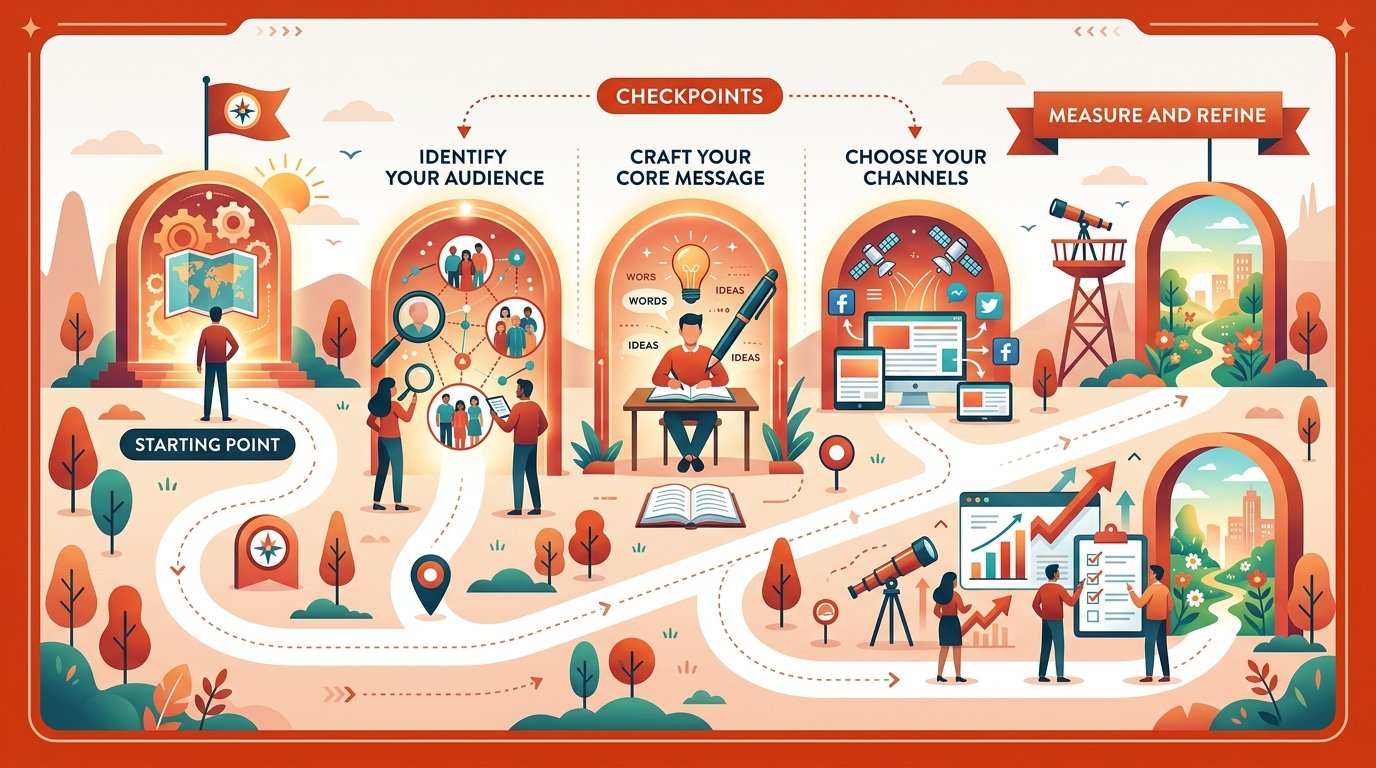
If you have never worked on storytelling in a systematic way, the simplest starting point is to identify the stories you already have and are not yet telling. Every company has narrative material; the challenge is to recognise it and structure it.
Follow these steps to get started:
- Identify your protagonist customer: choose a real customer profile and write their story before and after working with you. Be specific.
- Define the central conflict: what was their main problem? What prevented them from solving it on their own?
- Describe the transformation: what changed? What can they do now that they could not before?
- Extract the message: what does this story say about your brand’s values or value proposition?
- Choose the channel: adapt the format to the medium — a LinkedIn post, an email, a section of your website, a Reel — without losing the essence of the story.
At Amara, marketing engineering, we work through this process with entrepreneurs and marketing teams who want to stop selling features and start generating a real emotional connection with their audience. Storytelling is not a creative resource reserved for large brands; it is a strategic competence that any company can develop with the right approach.
What mistakes to avoid in business storytelling
Knowing the theory of storytelling does not guarantee its correct execution. These are the most frequent mistakes you should avoid:
- Making the brand the hero: the protagonist must be the customer, not your company. If your story starts with “we are…”, it starts badly.
- Forcing the product into the narrative: the product or service must appear as a natural consequence of the story, not as an advertising interruption.
- Ignoring consistency across channels: a fragmented business narrative — one story on Instagram and a different one on the website — erodes brand identity.
- Prioritising emotion over truth: an emotional but implausible story generates distrust. Emotion must arise from real facts, not exaggerations.
- Not including a call to action: storytelling connects; the CTA converts. A story without a next step leaves the reader without direction.
Avoiding these mistakes makes the difference between a story that moves people and one that, in addition, generates measurable results for your business.
Frequently asked questions about business storytelling
Does storytelling only work for large brands?
No. Storytelling is especially powerful for small and medium-sized businesses because it allows them to compete on differentiation when they cannot do so on advertising budget. An SME with an authentic story connects more than a large brand with a generic advertisement.
How long does it take to see results with storytelling?
Storytelling builds long-term assets: brand recognition, trust and loyalty. The first effects — greater engagement, more time on page, better email open rates — are usually noticed within weeks. The consolidation of the business narrative as a competitive advantage is a process of months.
Is storytelling the same as branded content?
Not exactly. Branded content is a format of content sponsored by a brand. Storytelling is a narrative technique that can be applied within branded content, but also in any other channel: email, web, presentations or social media. Storytelling is the tool; branded content can be one of its vehicles.
How do I measure whether my storytelling is working?
The most relevant metrics are: engagement rate on social media (comments, shares), time spent on pages with narrative content, open rate and clicks in story-format emails, and, in the long term, conversion rate and customer retention. Combine quantitative metrics with qualitative feedback from your audience.
Are there differences between B2B and B2C storytelling?
Yes, although the narrative structure is the same. In B2C, the conflict is usually emotional or aspirational; in B2B, the conflict is more frequently operational or business-related (inefficiencies, costs, risks). In B2B, furthermore, the protagonist can be a team or a department head, and the transformation must be expressed in terms of measurable business results, not just personal wellbeing.
Sources
- Datademia — Data Storytelling: how to tell stories with data (Chip Heath study, Stanford)
- Infosol — Data storytelling: how companies can transform data into memorable stories
- Elio Estudio — 3 Examples of Brilliant Storytelling that Made History
- Blackpool Digital — 6 examples of brand storytelling
- IEBS Business School — The power of storytelling: the case of Apple
- HubSpot — Video Marketing Statistics 2025
- Neurona.org — Inbound marketing trends 2024-2025: video storytelling
- Think with Google — The best creative YouTube ads 2024
- OBS Business School — Most used storytelling techniques in marketing
- Euncet — Corporate storytelling: how to build narratives that connect with the audience