

Last reviewed: June 2026
Contenidos
Keeping up with the latest technology trends is essential for professionals, enthusiasts and curious minds alike. But with hundreds of tech publications available, the real question is not whether good technology blogs exist, but which ones truly deserve your time.
In this article we present the 12 best technology blogs you can follow right now, in both English and Spanish. The selection is not arbitrary: we have evaluated each outlet according to specific criteria that we explain below. Whether you are looking for minute-by-minute tech news or prefer in-depth analysis on artificial intelligence, cybersecurity or the digital impact on society, you will find your reference here.
Selection criteria: why these technology blogs and not others
To compile this ranking we applied four objective criteria that distinguish a quality digital technology outlet from the rest. Each criterion carries a different weight in the final score:
- Verifiable audience (30%): monthly traffic verified with tools such as Semrush or SimilarWeb, reflecting the real reach of each publication. An outlet must exceed 500,000 monthly visits to enter the generalist ranking; niche specialists (cybersecurity, AI) can score with less traffic if they compensate in the other criteria.
- Publication frequency (20%): outlets that update their content regularly, with at least several new articles every week.
- Editorial reputation (30%): proven track record, informational rigor, visible fact-checking and recognition within the technology sector. This is the criterion with the greatest weight alongside audience, because a blog with millions of visits but no rigor does not make this list.
- Thematic coverage (20%): balance between current technology news, analysis, reviews and in-depth content on emerging science and technology.
The result is a list that combines the best science and technology blogs in Spanish — essential for Spanish-speaking audiences — with the most influential international tech publications, including for the first time two outlets specializing in AI and cybersecurity that complete the map.
Comparison table: the 12 technology blogs at a glance
| Blog | Language | Main topic | Approx. frequency | Estimated audience |
|---|---|---|---|---|
| Xataka | Spanish | Gadgets, consumer electronics, AI | Daily (20–30 art./day) | ~25 M visits/month |
| TechCrunch | English | Startups, funding, enterprise technology | Daily (50+ art./day) | ~17 M readers/month |
| Ars Technica | English | Hardware, science, tech policy | Daily (10–15 art./day) | High (millions/month) |
| The Verge | English | Technology, culture, entertainment | Daily (20+ art./day) | ~15 M visits/month |
| Hipertextual | Spanish | Technology, science, digital culture | Daily (5–10 art./day) | ~1.7 M visits/month |
| ExtremeTech | English | Hardware, science, gaming | Daily (5–10 art./day) | Medium-high |
| Engadget | English | Gadgets, digital entertainment, reviews | Daily (10–20 art./day) | ~8 M visits/month |
| WIRED | English | Technology, culture, society, AI | Daily (10+ art./day) | ~17 M visits/month |
| Genbeta | Spanish | Software, apps, digital productivity | Daily (5–10 art./day) | Medium |
| Teknautas | Spanish | Tech journalism, AI, cybersecurity | Daily (5+ art./day) | High (El Confidencial backing) |
| MIT Technology Review | English | AI, biotechnology, emerging technology | Daily (3–5 art./day) | ~1.3 M visits/month |
| Krebs on Security | English | Cybersecurity, cybercrime, investigation | Weekly (2–4 art./week) | 700K–1 M visits/month |
Why is Xataka the most-read Spanish-language technology blog?

Xataka is the undisputed leader among Spanish-language technology blogs. It is part of Weblogs SL and publishes new technological products on the market with rigor and passion. With nearly 25 million monthly visits according to Semrush data, it is the absolute reference Spanish-language technology channel.
Founded in 2004, it has built a community of influential and engaged users that makes it much more than a technology news outlet: it is a meeting point for the Spanish-speaking tech ecosystem. Since 2010 it has held its own awards recognizing the most innovative devices of the year, and organizes what it calls Tech Experiences, where the public can try products before their official launch. It also offers a daily newsletter and active RSS feed, making it easy to keep up with its publication pace without missing anything.
- Topics: consumer electronics, smartphones, tablets, consoles, video games, artificial intelligence
- Formats: reviews, market analysis, comparisons, current news
- Alternative channels: newsletter, RSS, mobile app, YouTube channel
- Language: Spanish
- Ideal for: anyone who wants to buy technology or follow tech news in Spanish
TechCrunch: the pulse of the startup ecosystem and tech funding
TechCrunch is one of the most established blogs in the world of tech publications. Founded by Michael Arrington, it stands out for its ability to generate an enormous amount of updated content: it publishes an average of several articles in each of its news categories every day, following current events by the second. Its media kit puts its audience at more than 17 million monthly readers, with a predominantly male profile between 25 and 34 years old linked to the business and technology world.
It uses an extremely informal but very engaging language, and bets on two-way communication: it always encourages collaboration from its followers and has no qualms about asking for help to improve the information it provides. Its specialty is the startup ecosystem, venture capital funding and enterprise technology. Its podcast Equity is one of the references in financial data journalism in the sector.
- Topics: startups, venture capital, AI, enterprise technology, cryptocurrencies
- Formats: current news, interviews, funding round analysis, podcast
- Alternative channels: newsletter, RSS, podcast Equity
- Language: English
- Ideal for: entrepreneurs, investors and technology sector professionals
Ars Technica: uncompromising technical analysis since 1998
Ars Technica is one of the most respected science and technology blogs in the world. Founded in 1998 by Ken Fisher and Jon Stokes, it focuses on providing detailed analysis and news on technology, science, tech policy, computer security, astronomy and physics. Its main hallmark is rigor: each article is built to break down complex technical topics in a clear and accessible way, without sacrificing depth.
Since its beginnings it has maintained a firm commitment to creating original high-quality content, avoiding the reuse of material from other outlets. The site’s design is clean and intuitive, and it complements its written articles with videos and podcasts that enrich the reader’s experience.
- Topics: hardware, software, science, computer security, tech policy
- Formats: in-depth analysis articles, news, podcasts, videos
- Alternative channels: newsletter, RSS, podcast Ars Technicast
- Language: English
- Ideal for: technology professionals and readers with an advanced technical background
The Verge: technology with cultural perspective and benchmark design

The Verge is a benchmark in international technology journalism. With around 15 million monthly visits according to Semrush data, it combines technology news coverage with culture, entertainment, science, business and automobiles, all wrapped in a modern and attractive design that sets it apart from other digital technology outlets.
What truly defines The Verge is its commitment to multimedia content: benchmark podcasts in the sector and a very active YouTube channel make the experience go far beyond the written article. It also organizes events and conferences that create spaces for debate about the role of technology in our lives.
- Topics: technology, science, entertainment, automobiles, tech companies
- Formats: articles, videos, podcasts, live events
- Alternative channels: newsletter, RSS, podcast Decoder, YouTube channel
- Language: English
- Ideal for: young and adult readers who want technology with a cultural perspective
Hipertextual: journalistic rigor and critical vision in Spanish
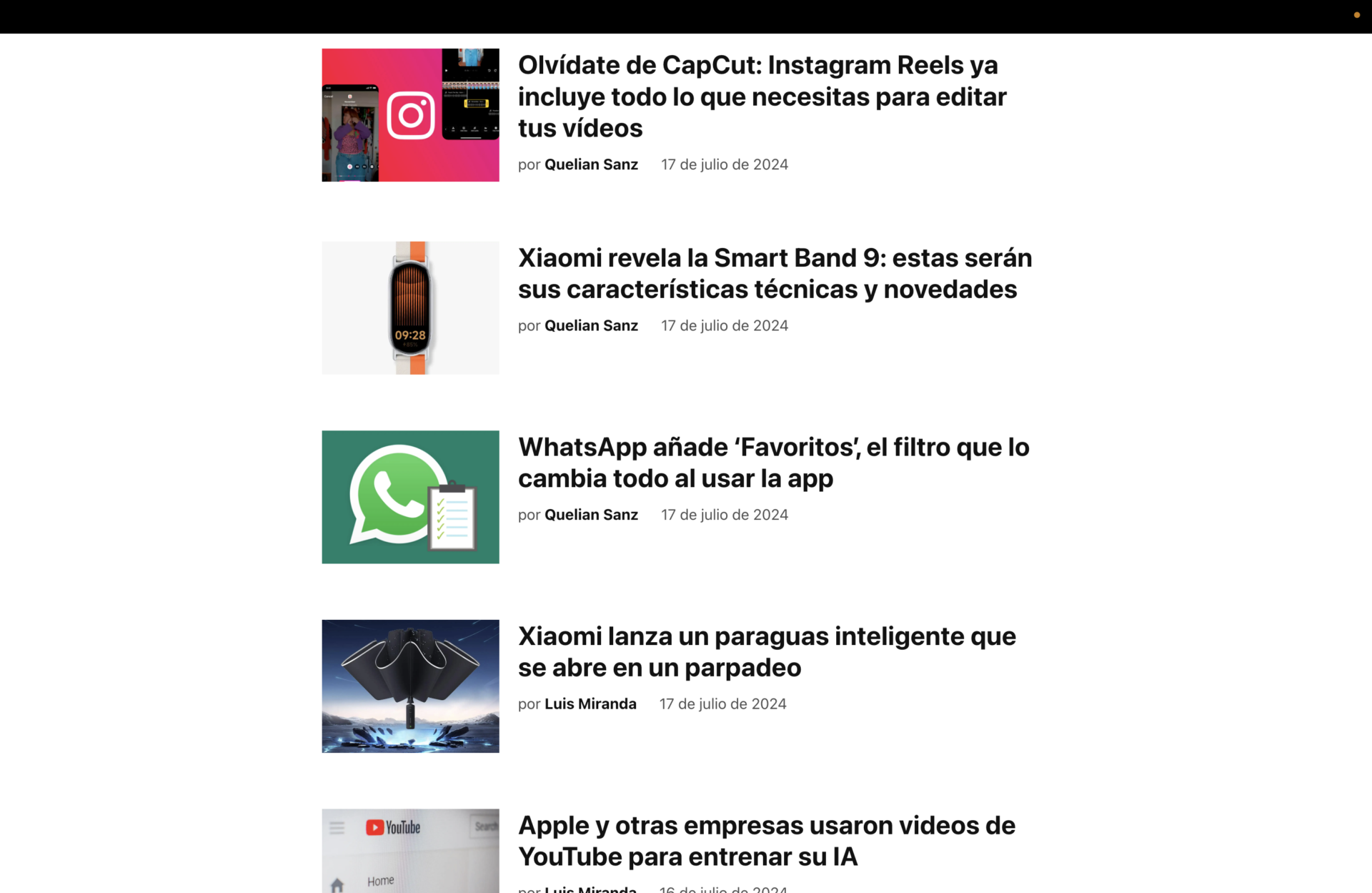
Hipertextual is the Spanish-language technology blog that best balances journalistic rigor and thematic breadth. With approximately 1.7 million monthly visits and an audience distributed across Spain, Mexico, Chile and Colombia according to Semrush, it is a reference publication for the entire Spanish-speaking community interested in digital current affairs.
Its content ranges from news and analysis to opinions and debates on artificial intelligence, cybersecurity, space exploration, climate change and social media trends. With a critical and rigorous approach, together with a clear and accessible style, Hipertextual goes beyond the technology news story to analyze the impact of technology on society. Its fact-checking process is visible and explicit, something unusual among Spanish-language digital technology outlets.
- Topics: technology, science, digital culture, AI, cybersecurity, space
- Formats: articles, podcasts, videos, interviews, special reports
- Alternative channels: weekly newsletter, RSS, podcast
- Language: Spanish
- Ideal for: Spanish-speaking readers who want depth and critical perspective
ExtremeTech: the benchmark for specialized hardware enthusiasts

Founded in 2001, ExtremeTech is one of the most veteran portals among international technology blogs and remains very active today. Its offering covers computing, mobile phones, automobiles, video games and science from a more specialized perspective than most of its competitors.
The key to its success lies in its team: according to the outlet itself, its writers are true technology lovers who have built their professional careers in the sectors they cover. That experience shows in the technical depth of its articles, which are complemented with photos and videos to make reading more enjoyable.
- Topics: hardware, computing, science, video games, automotive
- Formats: technical articles, analysis, news with multimedia
- Alternative channels: RSS, newsletter
- Language: English
- Ideal for: hardware enthusiasts and readers with an advanced technical profile
Engadget: accessible reviews and digital entertainment in one place
Engadget is one of the most up-to-date and interesting digital technology outlets today, with around 8 million monthly visits according to Semrush. Like other blogs, it covers news in computing, mobile phones, science and video games, but it stands out in two specific ways.
First, it dedicates a significant portion of its content to online entertainment: streaming platforms, YouTube, social media. Second, its writers publish reviews with an informal and approachable tone, always accompanied by photos and videos, which keeps the reader’s attention from start to finish.
- Topics: gadgets, digital entertainment, streaming, science, video games
- Formats: informal reviews, news, videos, product comparisons
- Alternative channels: newsletter, RSS, podcast Engadget Podcast
- Language: English
- Ideal for: technology consumers looking for accessible and entertaining reviews
WIRED: analysis of the social and cultural impact of technology
WIRED belongs to Wired Magazine, an American magazine founded on January 2, 1993 and currently owned by Condé Nast. With nearly 17.5 million monthly visits according to Semrush, it is one of the most influential tech publications in the world. But what distinguishes WIRED from the rest is not its traffic, but its approach: it analyzes the impact of technology on society, culture, the economy and politics, inviting the reader to think beyond the gadget.
Its investigative articles and long-form reports on artificial intelligence, cybersecurity and technology ethics make it a reference for those seeking depth, not just speed. WIRED organizes its content into thematic blocks — culture, business, science, security — so that each reader can quickly find what interests them. It also has local editions in several countries and a newsletter with a strong reputation in the sector.
- Topics: AI, cybersecurity, science, culture, business, tech policy
- Formats: investigative reports, analysis, interviews, opinion articles
- Alternative channels: newsletter, RSS, local editions (UK, Italy, Japan, Germany)
- Language: English (with local editions in several countries)
- Ideal for: readers who want in-depth analysis of the social impact of technology
Genbeta: the Spanish-language technology blog for mastering your digital tools

Genbeta is the Spanish-language technology blog specializing in software, applications and online services. It also belongs to the Weblogs SL group — the same as Xataka — and has become the reference for those who want to get the most out of their digital tools: from discovering new apps to optimizing productivity or solving everyday technical problems.
With a practical and approachable focus, Genbeta offers news and analysis of new developments, but also tips, guides and tutorials that set it apart from other more generalist outlets. Its team of experts shares applied knowledge on security, social media, tools for developers and advances in artificial intelligence.
- Topics: software, mobile and web applications, productivity, AI, cybersecurity
- Formats: tutorials, practical guides, news, app analysis
- Alternative channels: RSS, newsletter, Telegram channel
- Language: Spanish
- Ideal for: users who want to master their digital tools, from beginners to advanced
Teknautas: rigorous technology journalism backed by El Confidencial

Teknautas is the technology section of El Confidencial, one of the most widely read digital newspapers in Spain. This gives it something few Spanish-language technology blogs have: the backing of a top-level journalistic newsroom and an already consolidated audience of millions. Its approach is that of rigorous technology journalism: it investigates, contextualizes and explains technological advances with a level of depth that is unusual in generalist digital technology outlets.
Teknautas tackles the most complex topics in the tech world — artificial intelligence, cybersecurity, science and emerging technology — without losing sight of the impact these have on society and on people’s lives. An excellent option for those who want technology news with quality journalistic perspective.
- Topics: AI, cybersecurity, science, emerging technology, social impact
- Formats: reports, analysis, current news
- Alternative channels: El Confidencial newsletter, RSS
- Language: Spanish
- Ideal for: readers looking for rigorous technology journalism in Spanish
MIT Technology Review: the world reference in AI and emerging technology
MIT Technology Review is, alongside WIRED, the international tech outlet with the greatest intellectual authority. Founded in 1899 and backed by the Massachusetts Institute of Technology, its coverage is independent of any external influence, including the institution that funds it. This gives it a credibility that is hard to match in the landscape of technology blogs.
With approximately 1.3 million monthly visits according to SimilarWeb, its audience is not massive, but it is extraordinarily qualified: researchers, executives, investors and professionals who make strategic decisions about technology. Its annual lists — such as the “10 Breakthrough Technologies” or reports on the state of AI — become year after year reference documents cited throughout the sector. It has its own weekly newsletter and podcast that extend the reach of its data journalism.
- Topics: artificial intelligence, biotechnology, quantum computing, climate, emerging technology
- Formats: investigative reports, analysis, trend lists, podcast, EmTech events
- Alternative channels: newsletter The Download, RSS, podcast Deep Tech
- Language: English
- Ideal for: professionals and researchers who want to anticipate the technological future with scientific rigor
Krebs on Security: unfiltered investigative journalism in cybersecurity
Krebs on Security is the most influential cybersecurity blog in the world. It is written by Brian Krebs, an investigative journalist and former Washington Post reporter who has spent more than 16 years uncovering cybercrimes, data breaches and fraud networks on a global scale. Its loyal audience ranges between 700,000 and 1 million unique monthly visitors according to data published in its own media kit, with a profile heavily concentrated in security professionals and the financial sector.
It does not publish daily — unlike the other technology blogs on this list — but each article is an in-depth investigation that frequently gets ahead of generalist outlets by weeks or months in covering real threats. If your work or your company depends on cybersecurity, following this blog is not optional.
- Topics: cybersecurity, cybercrime, data breaches, online fraud, ransomware
- Formats: investigative reports, technical analysis, high-impact news
- Alternative channels: RSS, email newsletter
- Language: English
- Ideal for: computer security professionals, IT managers and any reader who wants to understand the real threats of the digital environment
Which is the best technology blog for you?
There is no single perfect technology blog for everyone. The choice depends on three variables: the language in which you prefer to consume content, your technical level and the topics that interest you most. Here is a quick guide to help you:
If you prefer content in Spanish
Start with Xataka if you are interested in gadgets and consumer electronics; with Hipertextual if you want technology with a scientific and social perspective; with Genbeta if your focus is on software and digital productivity; and with Teknautas if you value rigorous technology journalism with a Spanish context.
If you read in English and are looking for current technology news
TechCrunch is your outlet if you follow the startup ecosystem and tech funding. The Verge is the best generalist option with a modern design and a strong cultural component. Engadget stands out if you are looking for accessible reviews and digital entertainment.
If you want depth and analysis
WIRED is the reference for understanding the social and cultural impact of technology. Ars Technica is the choice if you have a technical profile and want rigorous analysis on hardware, science and tech policy. ExtremeTech completes the trio for the most specialized hardware enthusiasts. And if your interest is artificial intelligence or emerging technology at a scientific level, MIT Technology Review has no rival.
If you are starting from scratch
In Spanish, Genbeta or Xataka are the most beginner-friendly entry points. In English, Engadget or The Verge offer an accessible tone without sacrificing informational quality. The key is to follow two or three technology blogs consistently rather than trying to read them all: consistency always beats quantity. Subscribe to their newsletters or add their RSS feeds to a reader like Feedly or Inoreader to centralize all content in one place without depending on social media algorithms.
If you also want to turn these sources into part of your content strategy or digital marketing, you may be interested in exploring how to integrate tech media monitoring into your workflow. Following the best technology blogs is the first step; the second is knowing what to do with that information to make better decisions.