

If you don’t know where your competitors are, you’ll hardly know where to direct your strategy. Competitive analysis is the systematic process that allows you to understand the market in which you compete, identify the strengths and weaknesses of your rivals, and make informed decisions to build a real advantage. In this article I explain how to do it step by step, what tools to use and how to apply benchmarking effectively.
Contenidos
What is competitive analysis and why does it matter?
Competitive analysis is a competitive intelligence discipline that consists of collecting, organizing and interpreting information about the players competing in your same market space. It’s not about spying on the competition, but about understanding the environment to position yourself better.
For an entrepreneur or manager, this analysis answers critical questions: what do others offer that you don’t? Where are there uncovered market gaps? What is your differential value proposition compared to what already exists? Without these answers, any strategic decision is, to a large extent, a blind bet.
Furthermore, competitive analysis is not a one-time exercise. The market changes, competitors evolve and new players appear. Making it a periodic habit is what separates reactive companies from those that lead their sector.
How to do a competitive analysis step by step?
The methodology doesn’t have to be complex. Follow these steps to structure the process in a clear and actionable way.
1. Define the scope and competitors to analyze
Before collecting data, you need to know who to analyze. Distinguish between direct competitors (they offer the same product or service to the same audience) and indirect competitors (they satisfy the same need in a different way). Start with a list of five to ten relevant players; more than that disperses the analysis.
2. Choose the dimensions of analysis
Decide what you want to compare. The most useful dimensions are usually:
- Product or service: features, quality, range.
- Price: positioning and pricing structure.
- Distribution channels and digital presence.
- Communication and brand tone.
- Value proposition and perceived differentiation.
- Market share or online visibility.
3. Collect data from reliable sources
This is where competitive intelligence comes into play as a practice. Use public sources: corporate websites, social media, customer reviews, industry reports, commercial registers and search results. The information that competitors themselves publish about themselves is, frequently, the most revealing.
4. Analyze and draw conclusions
Organize the data in a comparative matrix. Look for patterns: where do all competitors coincide? That defines the market standard. Where are there absences or weak points? That’s where your opportunity may lie. The goal is not to accumulate information, but to turn it into concrete decisions.
What is benchmarking and how does it differ from competitive analysis?
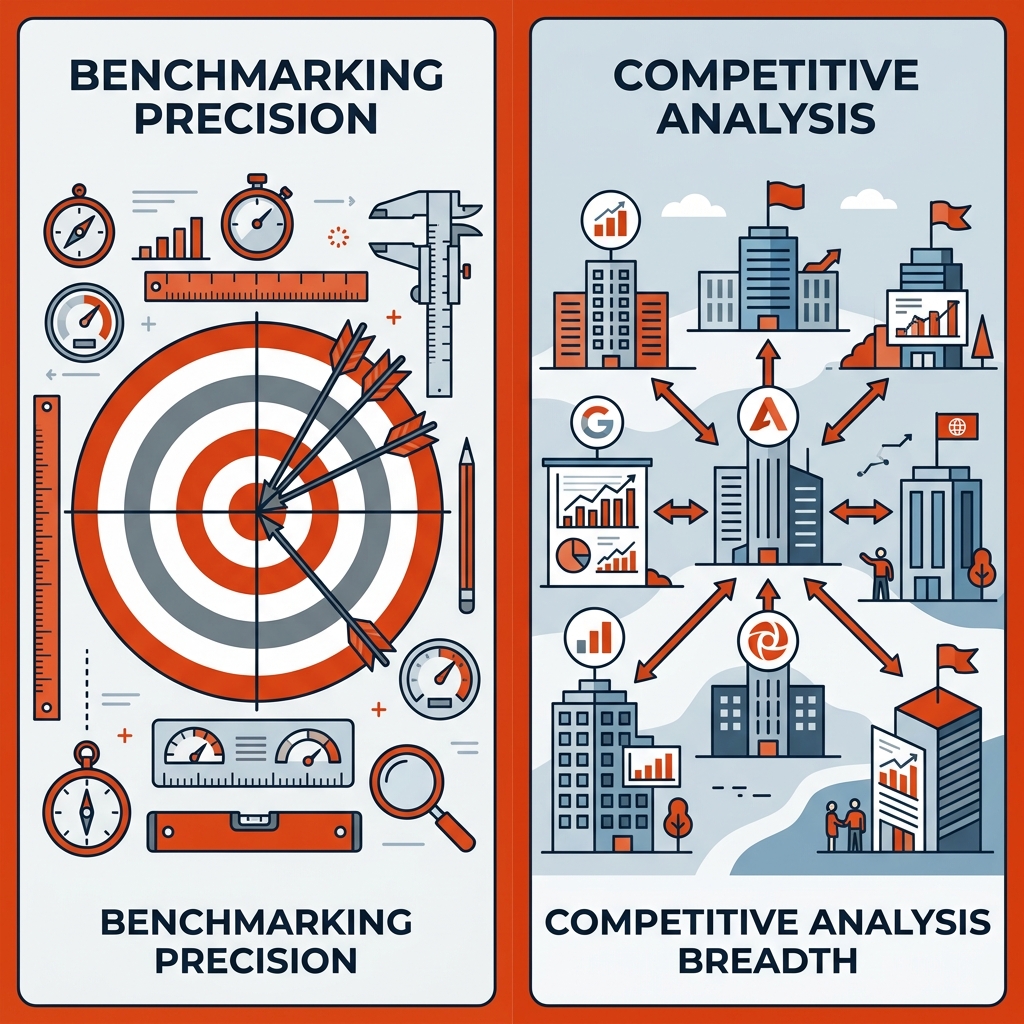
Benchmarking is a complementary practice that consists of comparing your processes, metrics or results with those of sector references —not necessarily your direct competitors— to identify performance gaps and improvement opportunities.
While competitive analysis has a strategic and external perspective (what does the market do?), benchmarking has an operational and internal perspective (how do we perform against the best available standard?). In practice, both complement each other: first you understand the market, then you measure your performance against the best.
To do effective benchmarking, first define which metric or process you want to improve, identify who does it best (inside or outside your sector), analyze how they achieve it and adapt that learning to your context. It’s not about copying, but about learning and surpassing.
What tools can you use for competitive analysis?
The good news is that you don’t need a large budget to do quality competitive intelligence. There are accessible tools for different levels of depth.
- SEMrush or Ahrefs: to analyze the organic visibility of your competitors, their keywords and their content strategy.
- SimilarWeb: to estimate web traffic and acquisition channels for any domain.
- Google Alerts: to monitor competitor mentions in real time at no cost.
- LinkedIn: to observe team growth, strategy changes and employer brand positioning.
- Reviews on Google, Trustpilot or App Store: to detect real pain points of your competition’s customers.
The key is not to use all the tools, but to choose the ones that answer the questions that matter most for your business right now.
How to turn analysis into real competitive advantage?
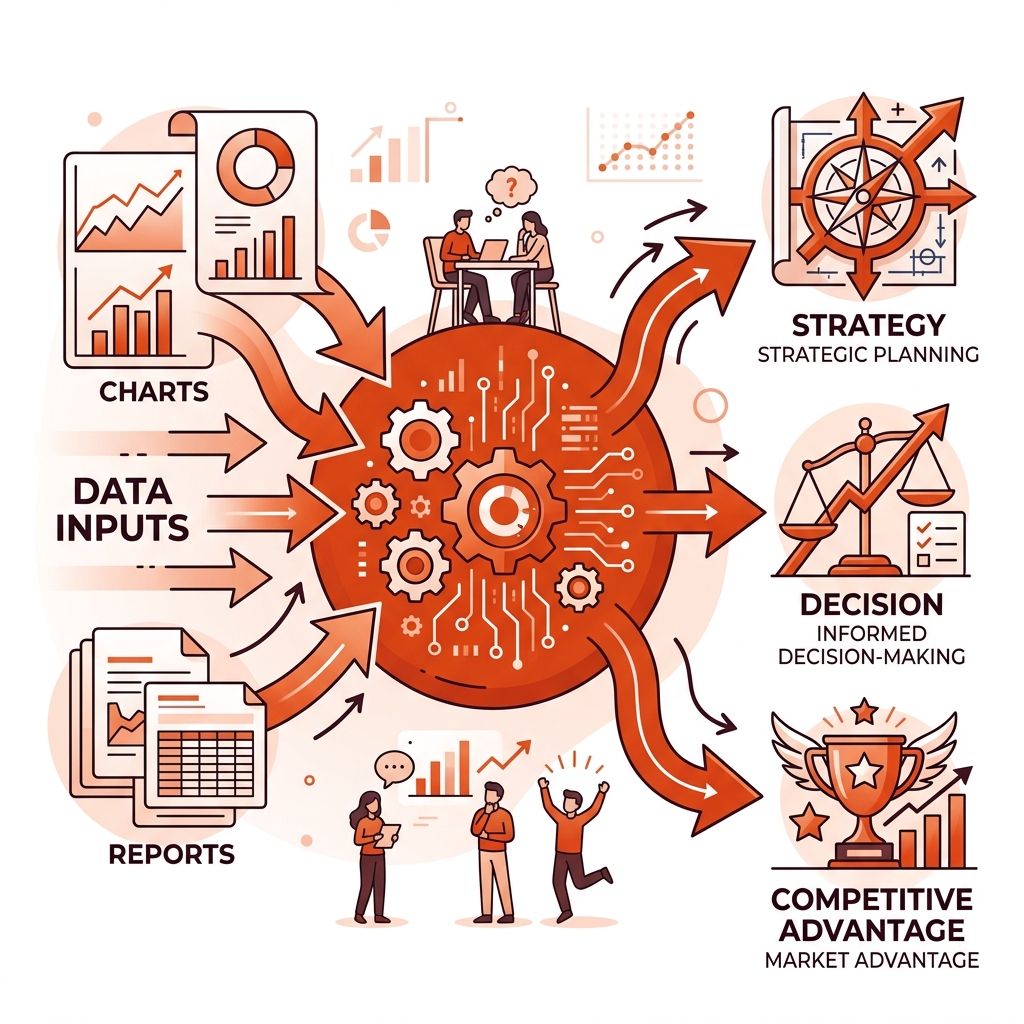
A competitive analysis without action is just a document. The real value comes when you connect the findings with concrete strategic decisions.
For example: if you detect that all your competitors have a confusing onboarding process according to their reviews, there you have a clear opportunity to differentiate yourself with a superior user experience. If you observe that no one in your sector is investing in educational content, it may be the moment to lead that conversation —as Amara, marketing engineering, does with its content approach oriented toward entrepreneurs and managers.
In short, competitive analysis and benchmarking are empowerment tools: they give you the map of the terrain so you can choose where and how to compete more intelligently. Competitive advantage is not improvised; it is built on data, judgment and consistent action.
If you want to take the next step and understand precisely where your business stands today, request a free marketing audit and discover your real potential with the support of a specialized team.
Frequently asked questions
How often should I update the competitive analysis?
It depends on the dynamism of your sector, but as a general rule, an in-depth analysis every six months is reasonable. For very fast-changing markets, a light quarterly review —focused on product news, prices and communication— keeps you up to date without consuming too many resources.
Is benchmarking only useful for large companies?
No. SMEs and entrepreneurs benefit especially from benchmarking because it allows them to learn from references without needing to invest in their own research. Comparing your conversion rate, your customer response time or your acquisition cost with sector standards is perfectly accessible at any scale.
What is the difference between competitive analysis and competitive intelligence?
Competitive intelligence is the continuous and systematic process of collecting and analyzing information from the competitive environment. Competitive analysis is a specific exercise within that process. In other words: competitive intelligence is the discipline; competitive analysis, one of its main tools.