
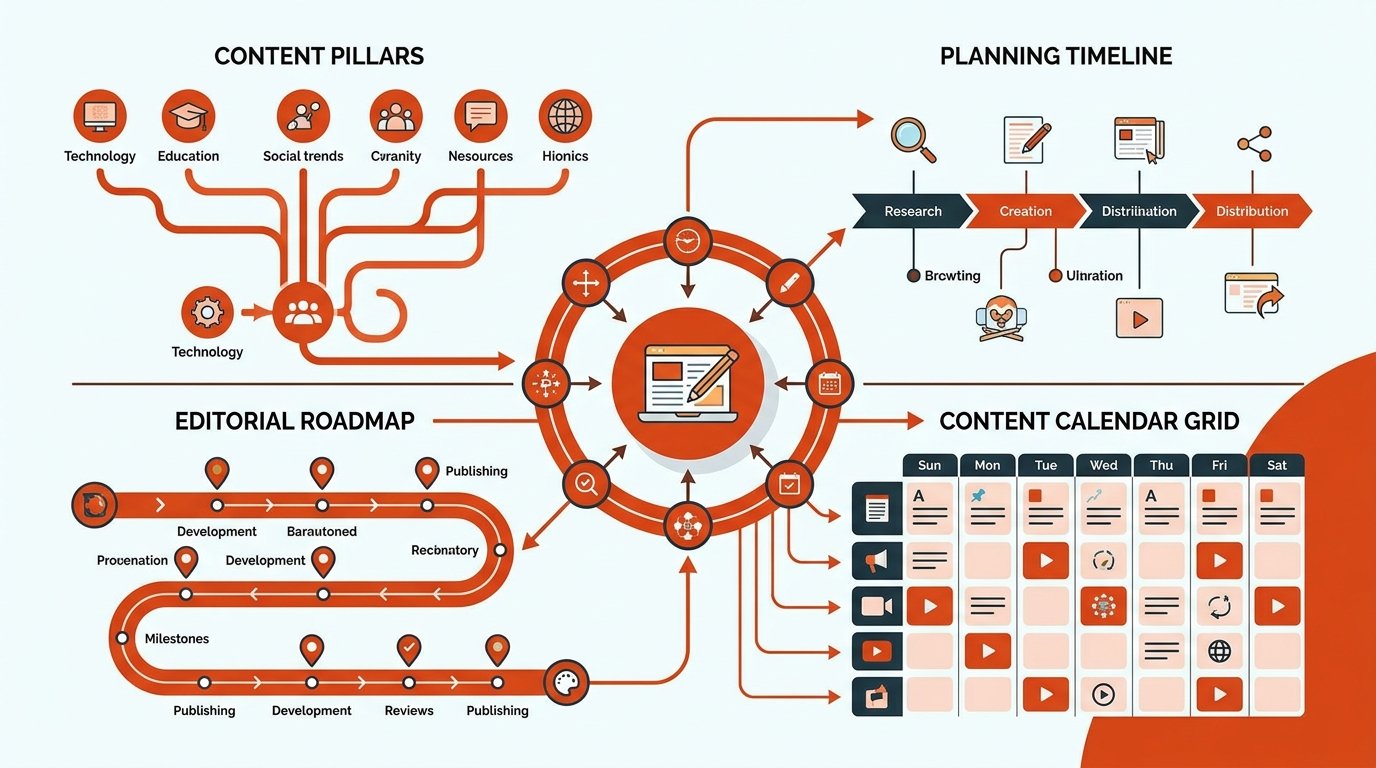
Publishing without direction is one of the most costly mistakes in digital marketing. Many companies generate content reactively —when there is time, when an idea comes up— and wonder why they get no results. The answer is almost always the same: they lack a content strategy that gives meaning to every piece they publish. In this guide we explain what it is, how to build it and how to translate it into an editorial calendar your team can execute week after week.
Contenidos
What is a content strategy?
A content strategy is the document that defines what content you are going to create, for whom, when you will publish it and what business objective each piece pursues. It is not a simple list of topics or a publishing calendar: it is the logic that connects every article, video or post to a measurable result.
The difference between having a strategy and not having one is the difference between publishing with purpose and publishing out of inertia. It is not a simple calendar: it is a strategic document that defines why you create content, for whom and how it will contribute to your objectives. When that logic is clear, every piece fulfils a function within the marketing funnel.
For a small business or entrepreneur, this is especially relevant: resources are limited and every hour invested in content must pay off. Good content planning avoids dispersion and concentrates effort where it truly has an impact.
Why do you need a content strategy?
The short answer: because without a strategy, content does not scale. Many brands create content consistently and still see no results. The problem is usually not frequency, but the lack of strategic direction.
A well-built strategy delivers concrete benefits that go beyond organisation:
- Brand consistency: a plan ensures your brand always speaks with the same voice and reinforces the same key messages, building trust and recognition over the long term.
- Alignment with the customer: it forces you to think about your customer first. Every article, video or post is created to resolve a real doubt or problem, which multiplies its impact.
- Resource optimisation: it puts an end to the blank-page syndrome. Knowing what you need to create each week allows you and your team to be far more efficient, reducing working hours and production costs.
- Long-term vision: a calendar lets you see your entire long-term marketing strategy, avoiding the repetition of topics or an excess of one type of content.
In short, it turns content into an asset, not an expense.
A real example: from publishing without a plan to attracting patients
To understand the practical impact, consider this case: a dental clinic in Madrid posted on Instagram irregularly —whenever someone on the team had time— and had a blog with four unupdated articles. There were no defined objectives or thematic coherence.
When building a content strategy, the first step was setting a single priority objective: attracting new patients interested in invisible orthodontics. From there, a specific buyer persona was defined (adults aged 30–45 looking for discreet aesthetic solutions), keywords with transactional search intent were identified (“invisible orthodontics price Madrid”, “clear aligners adults”) and a monthly calendar was designed with four blog articles, eight Instagram posts and a fortnightly newsletter.
In three months, organic traffic to the blog grew by 140% and budget enquiries via the web form doubled. The change was not publishing more: it was publishing with a clear purpose and a plan to sustain it. This same framework —objective, audience, topics, calendar— works equally well for an accounting firm, a fashion store or a design agency.
How to plan your content strategy step by step?
Building a content strategy does not require large resources, but it does require an orderly process. These are the fundamental steps:
1. Define your business objectives
Everything starts here. Before thinking about topics or formats, ask yourself: what do you want to achieve with content? The most common objectives are increasing organic traffic, generating qualified leads, improving customer retention or positioning yourself as a reference in your sector.
Every piece of content you plan must respond to one of those objectives. If a piece of content does not contribute to any of them, it probably should not be there. Defining the objective before the topic is the difference between an editorial calendar that generates business and one that only fills a Google Sheets file.
2. Know your audience in depth
Content that does not speak directly to a specific person speaks to no one. You need to define your buyer persona: who they are, what problems they have, what questions they ask and on which channels they consume information. The more precise that portrait is, the more relevant your content will be and the easier it will be to choose the topics that truly interest your audience.
3. Research keywords and search intent
Keyword research is not just an SEO task: it is the way to understand what real questions your audience is asking. Every term you research reveals a need you can address with content. Group topics into thematic clusters to reinforce your authority in each area and connect the pieces to one another.
To carry out this research effectively, here are the most useful tools for each stage:
- Google Search Console: ideal if you already have traffic. It shows you which real terms people use to find you and which ones have room for improvement in CTR or position.
- Semrush or Ahrefs: perfect for analysing search volume, ranking difficulty and the keywords your competitors use. Essential if you are starting from scratch or want to scale.
- AnswerThePublic: useful in the ideation phase. It generates real questions people ask around a topic, making it easier to create content aligned with informational search intent.
According to the Content Marketing Institute, organisations with a documented content strategy are three times more likely to report success than those operating without one. Keyword research is the first step to documenting it well.
4. Choose formats and channels
Not all formats work equally well for all objectives or all audiences. A long blog article ranks on Google and educates; a short video on social media generates reach and engagement; a newsletter builds loyalty among those who already know you.
The key is to choose the channels where your audience is, not the ones that are trending. This involves defining the audience, setting clear objectives, choosing content types, planning the publishing calendar and selecting the right distribution platforms.
5. Set your publishing frequency
Consistency matters more than volume. It is better to publish one solid article a week than three mediocre ones. Define a cadence you can maintain with the resources you have: if you work alone, one weekly blog post plus three social media posts can be a reasonable starting point. If you have a team, you can scale. A strategy that is not executed is worthless.
What is an editorial calendar and how does it differ from a content plan?
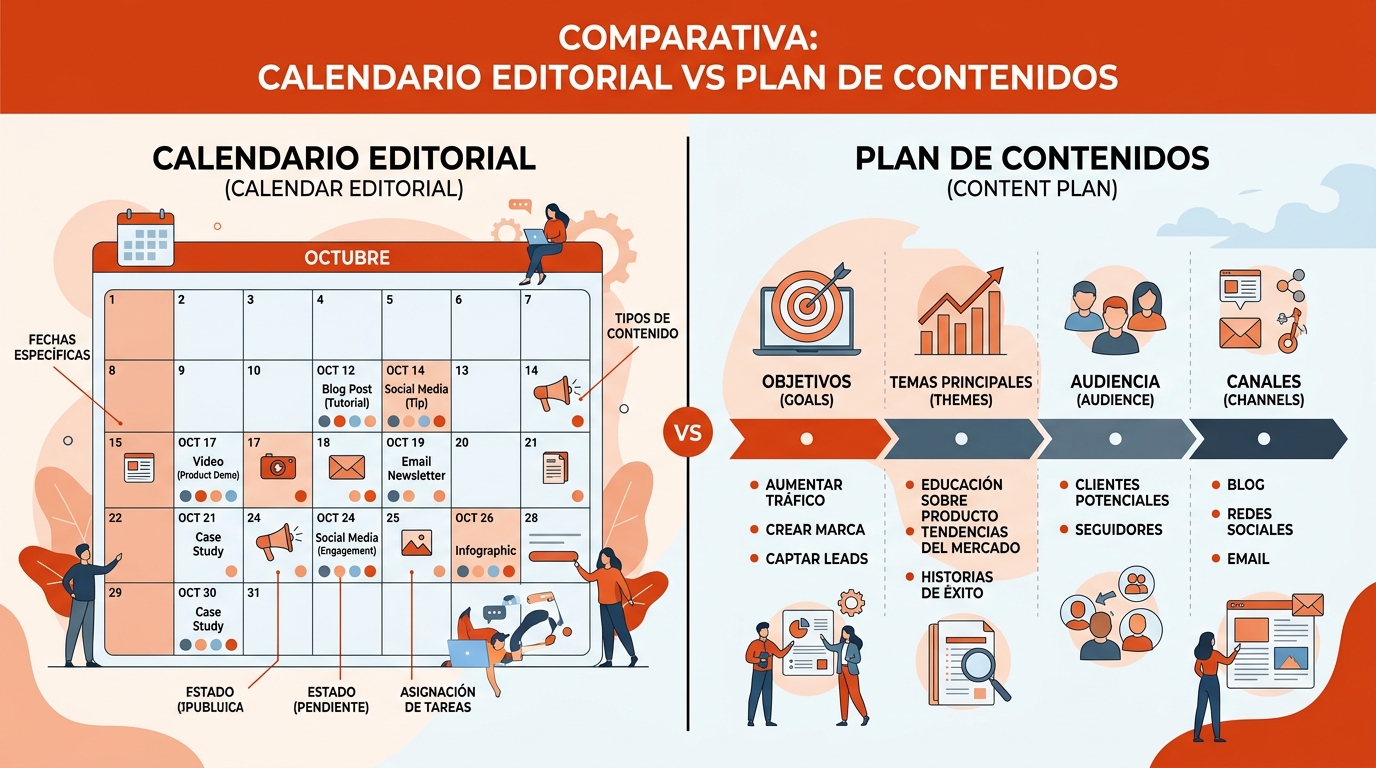
The content plan is the strategy: it defines objectives, audience and messages. The editorial calendar is the execution: it translates that strategy into concrete actions with dates, owners and metrics.
A content calendar is a planning tool that helps you organise in advance what you are going to publish, when, in what format and on which platform. Its main objective is to give you a global view of all your publications across different digital channels —blog, social media, email— so that you can coordinate your content marketing strategy with time to spare.
In practice, both tools are complementary and inseparable. Without a plan, the calendar is just a table with dates. Without a calendar, the plan is just theory.
How to build the editorial calendar step by step?
Once you have the strategy defined, the editorial calendar is the bridge to action. Here is the process:
Step 1: Choose the tool
You do not need anything sophisticated to get started. A simple Excel file can suffice, but it is advisable to work in Google Sheets to take advantage of the platform’s collaborative dimension. If your team is larger, tools like Notion, Trello or Asana add very useful task management layers.
The rule is simple: use the tool your team will actually consult. The best calendar is the one that gets used, not the prettiest one.
Step 2: Define the essential columns
An editorial calendar optimised for SEO should include: main keyword, search intent, funnel stage, content format, publication channel, CTA and performance metrics. Add to this the publication date, the person responsible and the content status (pending, in writing, under review, published).
With those columns you have everything you need to coordinate production and measure results without unnecessary complications. Below is a reference template you can replicate directly in Google Sheets:
| Title / Topic | Format | Channel | Main Keyword | Intent | Funnel | Pub. Date | Owner | Status | Target KPI |
|---|---|---|---|---|---|---|---|---|---|
| What is on-page SEO | Blog article | Blog | on-page SEO | Informational | TOFU | 15/09 | Ana G. | In writing | Organic sessions |
| Success stories: client X | Landing page | Website | marketing agency SMEs | Commercial | BOFU | 22/09 | Carlos M. | Pending | Conversions / leads |
| Newsletter: September updates | Newsletter | — | Retention | MOFU | 30/09 | Ana G. | Pending | Open rate / clicks |
You can copy this structure into Google Sheets and adapt it to your team. What matters is that each row represents a piece of content and that all columns are filled in before production begins.
Step 3: Distribute topics over time
Take your idea bank —generated during the keyword research phase— and distribute it across the calendar according to the frequency you have decided on. Organise content into thematic blocks: this allows you to work on a topic from different angles and reinforce topical authority in a sustained way.
Alternate content types: educational, inspirational, commercial, entertainment. An effective editorial calendar combines different types of publications with different strategic objectives, so that each week there is at least one piece aimed at attracting new traffic and another at converting or retaining those who already know you.
Step 4: Assign owners and deadlines
Break each type of content down into the tasks needed to complete it —research, writing, editing—. If you work with a team, assign each person the specific tasks within the calendar. This avoids bottlenecks and last-minute misunderstandings.
In addition, always reserve a margin for current-affairs content. Maintain flexibility for last-minute adjustments without affecting the overall plan. Reserve spaces in the calendar to react to sector news without disrupting the strategy.
Step 5: Measure, learn and adjust — KPIs by objective
An editorial calendar is not a static document. Regularly review the performance of published content. But “measuring” does not mean looking at the number of visits: it means connecting each metric to the objective that justified that piece. Here are the most relevant KPIs for each objective:
- Objective: organic traffic. Measure organic sessions, average position and CTR in Google Search Console. If the position rises but CTR does not improve, the problem lies in the title or meta description, not in the content.
- Objective: lead generation. Measure conversions (forms submitted, downloads, demos requested) and cost per lead if you use paid media to amplify. Tools like Google Analytics 4 or HubSpot allow you to attribute each lead to the content that originated it.
- Objective: engagement and community. Measure open rate and clicks in newsletters, comments and saves on social media, and average time on page for blog articles. A high time on page indicates that the content responds well to search intent.
- Objective: retention and loyalty. Measure returning user rate, visit frequency and churn rate among email subscribers. Content that builds loyalty reduces acquisition costs over the long term.
Ideally, review these metrics monthly and make deeper quarterly adjustments, analysing performance, changes in search trends and business results. If a format does not work after three months of testing, change it: data is your best ally for making that decision.
What elements should a complete editorial calendar include?
For the calendar to be useful in day-to-day management, it must include at least these fields for each piece of content:
- Title or topic: the specific subject to be covered.
- Format: blog article, video, infographic, newsletter, social media post, etc.
- Publication channel: blog, Instagram, LinkedIn, YouTube, email…
- Main keyword and search intent (for SEO content).
- Funnel stage: attraction (TOFU), consideration (MOFU) or decision (BOFU).
- Publication date and delivery deadline.
- Owner for writing, editing and publishing.
- Status: pending, in progress, under review, published.
- Target metrics: which KPI will measure the success of that piece.
Each of these fields provides essential information about the content strategy to the different stakeholders in the editorial project. This tool quickly becomes essential if your strategy involves several people: everyone can consult it to know exactly what they need to do and when, so that everyone works in the same direction and in line with the marketing objectives.
Common content management mistakes you should avoid
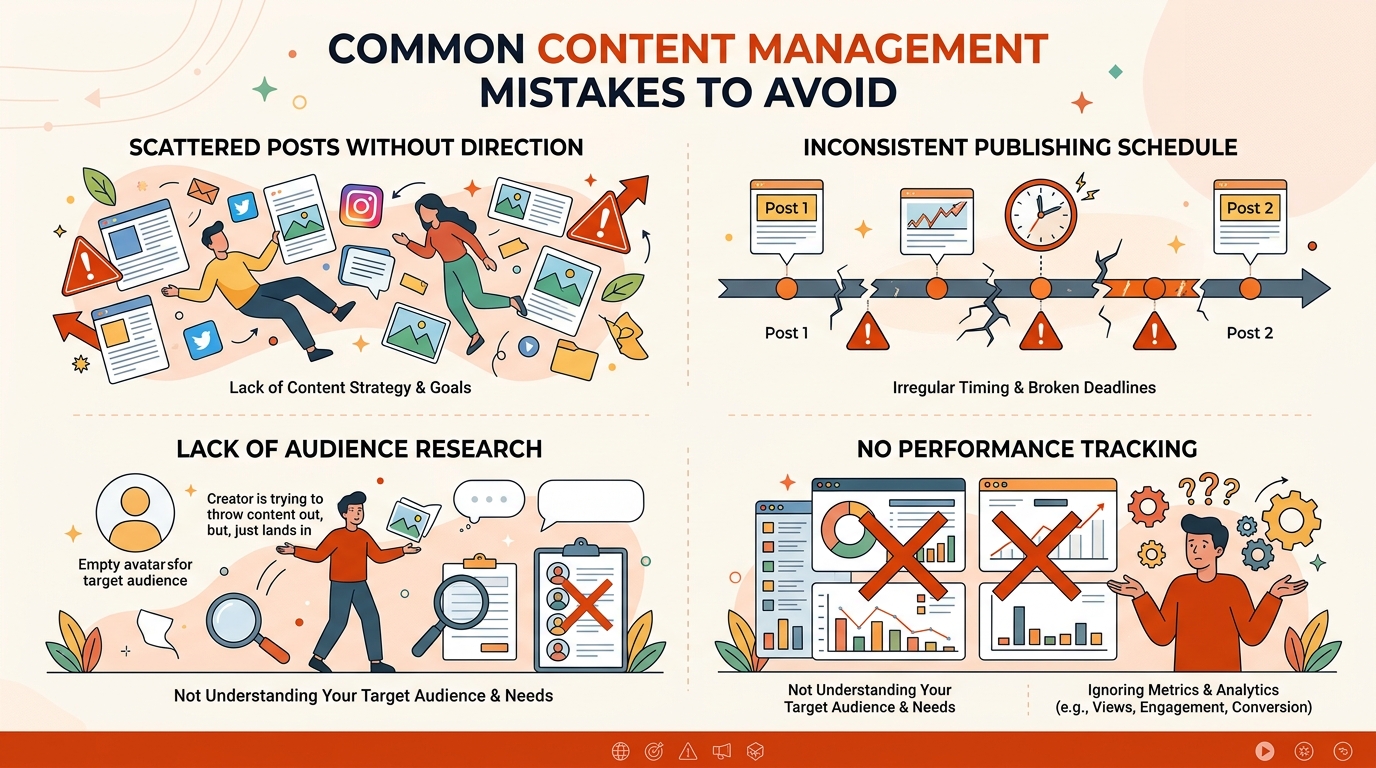
Knowing the most common mistakes is just as valuable as knowing what to do right. These are the ones that most frequently undermine results:
- Publishing without a clear objective: creating content without planning is one of the most common mistakes in digital marketing. Basing production solely on the inspiration of the moment usually ends in scattered efforts and few results.
- Confusing the calendar with the strategy: the calendar organises; the strategy gives meaning. Without the latter, the former is just an empty table.
- Ignoring measurement: if you do not measure, you do not know what works or what to improve. Content management without data is blind management.
- Overestimating available resources: planning more content than can be produced with quality generates stress and mediocre pieces. Less and better always wins.
- Not updating existing content: content calendars are also useful for planning periodic audits and reviewing or refreshing articles that are no longer generating traffic or have become outdated.
Where to start if you are starting from scratch?
If you have never had a formal content strategy, the first step is not to build a twelve-month calendar. It is far more practical to start with a four-to-six-week horizon, validate what works and scale from there.
Going back to the dental clinic example: they did not start with an annual plan. They started with one objective, four articles and eight posts. In six weeks they had enough data to know which topics resonated with their audience and which format converted best. That information was worth more than any theoretical twelve-month plan.
At Amara, marketing engineering, we work with SMEs and marketing teams to structure their digital presence from strategy through to execution. Knowing what to publish, when and for whom should not be an unknown: it is the starting point of any content marketing action that aims to generate real results.
If you want to stop improvising and start building a content strategy that works for your business, the first step is to understand where you stand right now.
Frequently asked questions
What is the difference between content strategy and content marketing?
Content marketing is the general discipline that uses content as a tool for attraction and conversion. Content strategy is the specific plan that defines how that discipline is applied in your business: what you publish, for whom, how often and with what objective. One is the framework; the other is the action map.
How often should I review my editorial calendar?
The most practical approach is to carry out light monthly reviews —adjusting topics, incorporating sector news— and deeper quarterly reviews where you analyse metrics, evaluate which formats are working and recalibrate objectives if necessary. A calendar that is not reviewed quickly loses relevance.
What is the best tool for managing the editorial calendar?
It depends on the size of your team and the level of detail you need. For small teams or solo work, Google Sheets is sufficient and has the advantage of being collaborative and free. For larger teams with approval workflows, Notion or Trello add very useful task management layers. What matters is choosing a tool your team will actually consult, not the most sophisticated one.
How much content should I publish per week?
There is no universal figure. What matters is consistency and quality. One well-crafted weekly blog article generates more long-term value than five mediocre posts. Define a cadence you can maintain with the resources you have and scale gradually when you have the capacity to do so without sacrificing quality.