
Retrieval Augmented Generation —known by its acronym RAG— is the technique that allows language models to consult an external knowledge base before generating a response. Instead of relying exclusively on what they learned during training, RAG systems retrieve updated and relevant information in real time and incorporate it into the context of each query. The result is an AI that responds with greater accuracy, fewer hallucinations, and verifiable data.
Contenidos
What Is Retrieval Augmented Generation and Why Does It Matter?
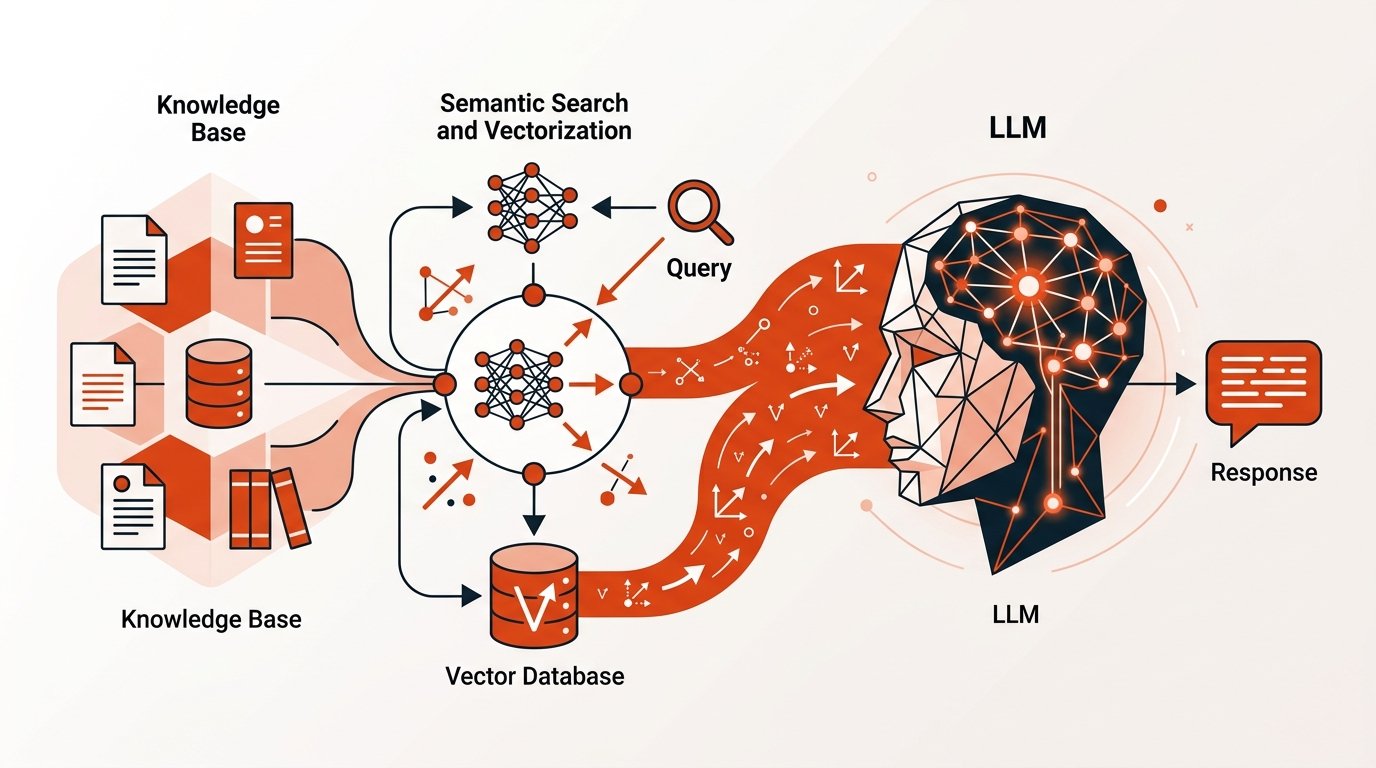
Retrieval Augmented Generation is an artificial intelligence architecture that combines two complementary capabilities: semantic search over a proprietary knowledge base and the generative capability of a large language model (LLM). The concept was formalized by Meta AI researchers in 2020 and has since become the reference pattern for building reliable enterprise AI systems. Today, retrieval augmented generation is the mandatory starting point for any team that wants to deploy AI with specific and up-to-date knowledge.
Generic language models —such as those powering ChatGPT or Gemini in their base versions— learn from enormous volumes of text during training, but that knowledge is frozen at a cutoff date. If you ask an LLM about your company’s return policy or a regulation published last month, it simply does not know. RAG solves exactly that problem: it connects the model with your real knowledge, whether internal documentation, corporate databases, or updated sources. That is why retrieval augmented generation is not just a technical improvement, but a structural change in how AI systems access information.
For any entrepreneur or developer who wants to integrate advanced AI into their processes, understanding retrieval augmented generation is the starting point. You do not need to train your own model —something that would require computational and financial resources beyond the reach of most small businesses—; you only need a well-designed RAG architecture.
What Problem Does RAG Come to Solve?
To understand why retrieval augmented generation is so relevant, it helps to first understand the limitations of LLMs without this mechanism. A standard language model has three structural problems that retrieval augmented generation addresses directly.
Outdated Knowledge
Language models are trained on data up to a specific date. Everything that happens after —regulatory changes, new products, price updates, recent news— is invisible to the model. In a business environment where information changes constantly, this is a critical problem. With RAG, knowledge is updated without retraining the model: it is enough to add or modify documents in the database. Retrieval augmented generation turns knowledge updating into an operational task, not an engineering project.
Hallucinations and Factual Errors
LLMs tend to “invent” information with total confidence when they do not know the answer. This phenomenon, known as hallucination, is especially dangerous in contexts where accuracy matters: customer service, legal advice, technical support. RAG drastically reduces this problem because the model generates responses based on real and verifiable text fragments it has previously retrieved. In this sense, retrieval augmented generation acts as a factual anchoring mechanism for the LLM.
Inability to Access Private Knowledge
A generic LLM does not know your company’s internal manuals, contracts signed with suppliers, or the specific procedures of your sector. Retrieval augmented generation allows the model to access that private information securely, without exposing it to model training or to third parties.
How Does RAG Work Step by Step?
The operation of RAG is structured in a pipeline with well-differentiated phases. Understanding each stage will help you make better decisions when implementing or evaluating a solution based on retrieval augmented generation.
Phase 1: Document Ingestion and Preparation
The first step consists of processing the documents that will form the knowledge base of the retrieval augmented generation system. This includes PDFs, web pages, Word documents, database records, articles, or any relevant text source. Documents are divided into manageable fragments —called chunks— to facilitate later retrieval. The size and fragmentation strategy are critical decisions that directly affect the quality of responses.
Phase 2: Embedding Generation and Vector Storage
Each text fragment is converted into a high-dimensional numerical vector called an embedding. These vectors represent the semantic meaning of the text, not the exact words. Two sentences with similar meaning will have close vectors in mathematical space, even if they share no words. These vectors are stored in a vector database (such as Pinecone, Weaviate, FAISS, or Chroma), which is optimized to perform similarity searches at high speed. This phase is the infrastructural core of retrieval augmented generation.
Phase 3: Semantic Retrieval for Each Query
When a user asks a question, the retrieval augmented generation system converts that query into an embedding and performs a semantic search in the vector database. The result is a set of text fragments whose meaning is closest to the question. This semantic search is much more powerful than a traditional keyword search: it finds relevant information even if the user does not use the exact terms from the document.
Phase 4: LLM-Augmented Generation
The retrieved fragments are injected into the language model’s context along with the original question. The LLM essentially receives the instruction: “Answer this question based on the following documents.” From there, it generates a coherent, accurate, and well-grounded response based on the real retrieved information. The model acts as an expert writer who synthesizes the sources in front of it. It is in this phase that retrieval augmented generation materializes its advantage over conventional LLMs.
What Are Vector Databases and Why Are They Essential in RAG?
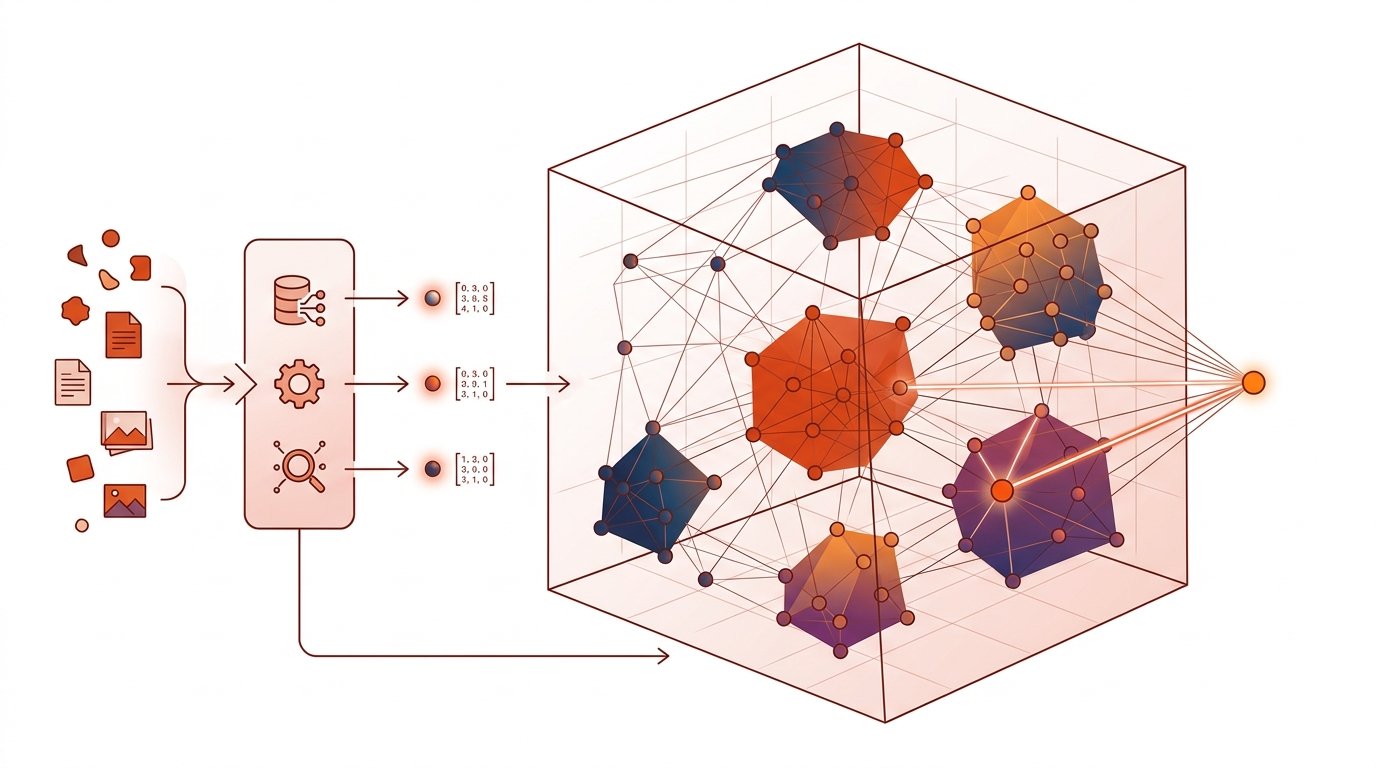
Vector databases are the infrastructure component that makes semantic search at scale possible in any retrieval augmented generation system. Unlike a classic relational database, which looks for exact matches, a vector database searches for mathematical similarity between vectors. This makes it possible to find relevant documents even if the user phrases the question differently from how the answer is written.
Some of the most widely used solutions in the RAG ecosystem are Pinecone (managed cloud service), Weaviate (open-source with native hybrid search), FAISS (Meta’s library optimized for speed), and pgvector (extension for PostgreSQL, ideal if you already use this database). The choice depends on document volume, latency requirements, and available budget. Each of these systems can be integrated into a retrieval augmented generation pipeline with relative ease.
A key aspect is hybrid search: combining semantic vector similarity with classic keyword search (BM25) improves result relevance, especially when users search for technical terms or very specific proper nouns. In advanced retrieval augmented generation implementations, hybrid search has become a recommended practice.
How Does RAG Differ from Model Fine-Tuning?
This is one of the most frequently asked questions when starting to work with retrieval augmented generation. Both RAG and fine-tuning allow you to specialize a language model, but they work in radically different ways and serve different purposes.
| Criterion | RAG | Fine-tuning |
|---|---|---|
| Implementation cost | Low-medium | High (GPU, labeled data) |
| Knowledge update | Immediate (add documents) | Requires retraining |
| Source traceability | High (cites source document) | Low (integrated knowledge) |
| Ideal for | Dynamic or private knowledge | Style, tone, or specific task |
In practice, RAG and fine-tuning are complementary, not mutually exclusive. A fine-tuned model can learn the tone and response format of your brand, while retrieval augmented generation provides it with the updated data to work with. For most small businesses and entrepreneurs, however, retrieval augmented generation is the most accessible starting point with the greatest immediate impact.
What Are the Most Relevant Use Cases for RAG in Businesses?
Retrieval augmented generation is not a laboratory technology: it is already in production at companies of all sizes. These are the use cases where retrieval augmented generation delivers the most value immediately.
- Customer service assistant: the model answers queries based on product documentation, FAQs, and company policies, always with updated and traceable information. Retrieval augmented generation ensures that responses always reflect the most recent version of each policy.
- Intelligent search in internal documentation: employees can ask questions in natural language about manuals, procedures, or contracts, and get precise answers with a reference to the source document.
- Automated technical support: the system retrieves the most relevant solutions from a technical knowledge base and presents them in a contextualized way to the user.
- Report and data analysis: retrieval augmented generation allows interrogating large volumes of documents —financial reports, market studies, meeting minutes— in a conversational manner.
- Legal and compliance assistants: the model consults regulations, contracts, and case law to answer specific questions with a verifiable documentary basis. In this domain, the traceability offered by retrieval augmented generation is especially valuable.
In all these cases, the common denominator is the same: the value lies not in the generic language model, but in connecting it with the specific knowledge of your business. That is exactly what RAG does.
What Are the Limitations of RAG and How Can They Be Mitigated?
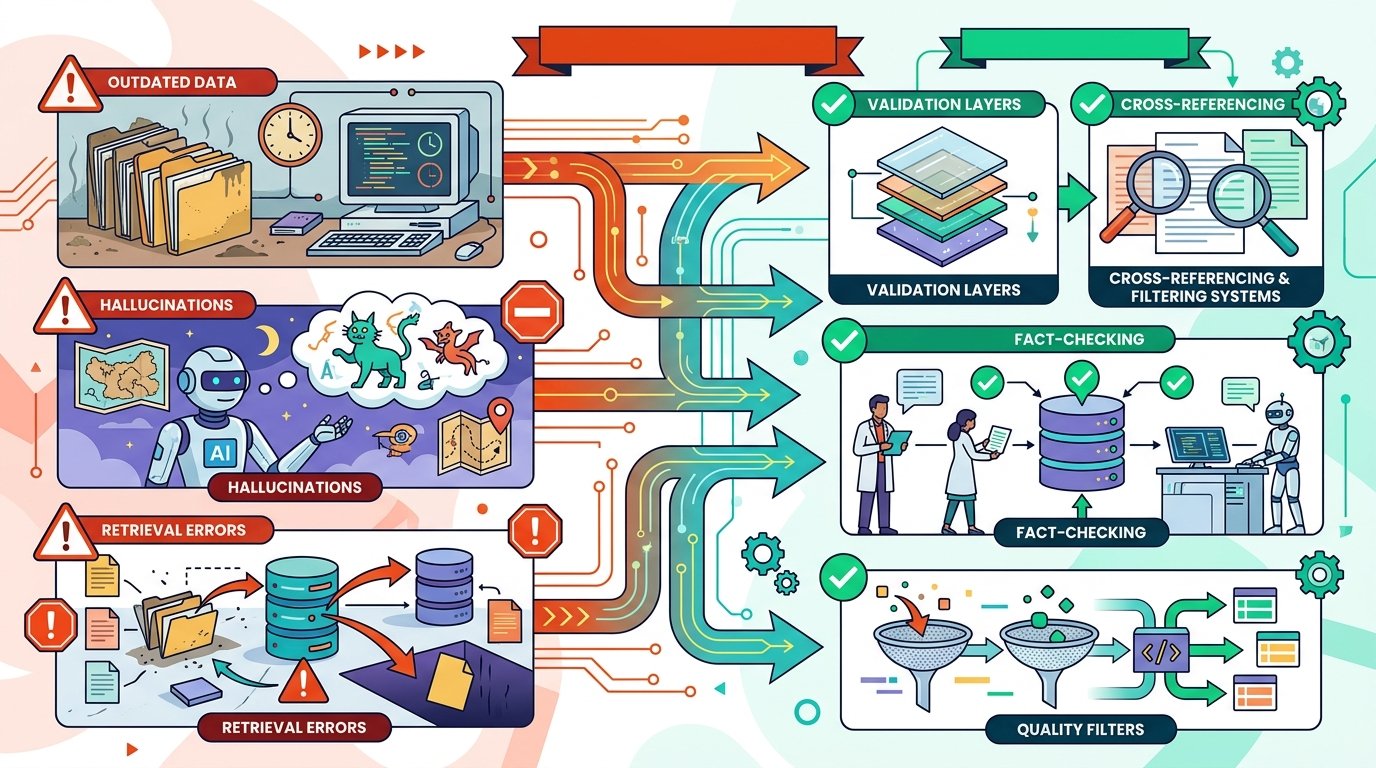
Like any technological architecture, Retrieval Augmented Generation has limitations that are worth knowing before implementing it. Identifying them from the outset avoids frustration and allows for the design of more robust retrieval augmented generation solutions.
Retrieval Quality: The Most Critical Link
If the system retrieves irrelevant or incomplete fragments, the model will generate incorrect responses even if it is very capable. The fragmentation strategy, the quality of the embeddings, and the semantic search configuration are the factors that most influence the final result of any retrieval augmented generation implementation. A powerful LLM does not compensate for a poor retrieval architecture.
Additional Latency
The RAG pipeline adds steps to the generation process: converting the query into an embedding, searching the vector database, and retrieving documents before generating the response. This introduces latency that must be managed through vector index optimization and caching strategies. In most conversational applications based on retrieval augmented generation, this latency is acceptable, but it must be measured.
Management of Outdated or Contradictory Documents
If the knowledge base contains obsolete information or documents that contradict each other, the model may generate confusing responses. Document governance —who can add documents, how often they are updated, how versions are managed— is just as important as the technical architecture in any retrieval augmented generation deployment.
How to Start Implementing RAG in Your Project?
If you are a junior developer or entrepreneur who wants to integrate retrieval augmented generation into a product or process, the most direct path involves three key decisions: which documents to index, which vector database to use, and which LLM to connect as the generator.
The open-source tooling ecosystem greatly facilitates getting started. Frameworks such as LangChain or LlamaIndex provide high-level abstractions that allow you to build a functional retrieval augmented generation pipeline in a few hours, connecting models from OpenAI, Anthropic, or other providers with vector databases like Chroma or FAISS. For production projects at greater scale, managed solutions like Pinecone or Weaviate reduce the operational burden of maintaining retrieval augmented generation infrastructure.
The recommended process for a first retrieval augmented generation project is as follows:
- Define the specific use case and the documents the model needs to address it.
- Preprocess and chunk the documents with a chunking strategy suited to the type of content.
- Generate the embeddings with a pretrained model (for example, those from OpenAI or open-source models like sentence-transformers).
- Store them in a vector database and configure the semantic search parameters.
- Connect the retriever with the LLM and design the prompt that tells the model how to use the retrieved context.
- Evaluate the quality of the responses with real questions and adjust the pipeline based on the results.
At Amara, marketing engineering, we work with teams that integrate retrieval augmented generation into their strategies and processes. Experience confirms that the biggest obstacle is not technical, but organizational: defining what knowledge the AI should have and keeping that knowledge base updated and well-structured. Solve that before writing a single line of code.
Frequently Asked Questions about Retrieval Augmented Generation
Do I need to know how to code to implement RAG?
To implement a retrieval augmented generation pipeline from scratch, programming knowledge is required, especially in Python. However, there are no-code platforms and SaaS solutions that allow you to connect documents with an LLM without writing code. For a serious production project, having a junior developer with knowledge of LangChain or LlamaIndex is a sufficient starting point.
Does RAG work with any language model?
Yes. The retrieval augmented generation architecture is agnostic with respect to the generative model: you can use it with models from OpenAI (GPT-4o), Anthropic (Claude), Google (Gemini), or open-source models like LLaMA or Mistral. The choice of LLM affects the quality of the final synthesis, but the semantic retrieval component of retrieval augmented generation works independently.
How much does it cost to implement a RAG system?
The cost of a retrieval augmented generation system depends on the volume of documents, the frequency of queries, and the services chosen. A functional prototype can be built with open-source tools at near-zero cost (only development time). In production, the main costs are vector storage, LLM API calls, and the compute infrastructure for generating embeddings. For a small business with a well-defined use case, monthly costs are usually very affordable compared to the value that retrieval augmented generation provides.
What is the difference between RAG and a conventional chatbot?
A conventional chatbot responds based on predefined answers or the model’s generic knowledge. A chatbot based on retrieval augmented generation retrieves specific information from your knowledge base before responding, which allows it to give accurate, up-to-date, and traceable answers to their documentary source. The difference in response quality is significant in any specialized domain.
Is it safe to use RAG with confidential company documents?
Yes, as long as the retrieval augmented generation architecture is correctly designed. Documents are stored in your own infrastructure or in services with appropriate privacy contracts, and are not shared with the LLM provider for retraining. It is essential to review the data usage policies of the chosen AI provider and, if the level of confidentiality is high, to consider models deployed on your own infrastructure.
Sources
- RAG Techniques: How They Work and Examples of Use Cases
- Retrieval-Augmented Semantic Parsing: Improving Generalization with Lexical Knowledge
- Retrieval-augmented generation
- A Tale of Trust and Accuracy: Base vs. Instruct LLMs in RAG Systems
- Can Compressed LLMs Truly Act? An Empirical Evaluation of Agentic Capabilities in LLM Compression