
The sales closing is the moment of greatest tension —and greatest opportunity— within any commercial process. All the prior work of prospecting, presenting and following up converges in a decisive instant: the customer says yes or says no. Knowing how to reach that moment prepared, with the right tools and mindset, makes the difference between a conversation that is lost and a deal that gets signed.
Contenidos

What is sales closing and why is it so critical?
Sales closing is the phase of the commercial process in which the salesperson invites the customer to make the final decision to buy a product or service. It is not a formality: it is the point where all the previous strategy demonstrates its real value.
Without an effective sales closing, the rest of the process loses relevance. You may have delivered a flawless presentation, built trust and demonstrated the value of your proposal; but if you fail to seal the deal, the opportunity evaporates. That is why the close is not the end of the sale —it is its natural culmination.
Moreover, a good sales closing does not only result in a successful transaction: it lays the foundations for a lasting relationship with the customer, which in the long run translates into loyalty, referrals and new business opportunities.
The data supports this perspective. According to HubSpot’s State of Sales report, only 27% of salespeople consider that their company closes deals efficiently, which points to an enormous margin for improvement in most commercial teams. Research by CSO Insights indicates that salespeople who follow a formal sales process achieve closing rates between 15% and 20% higher than those who improvise. Sales closing, in short, is a discipline —not an instinct.
When are you ready to close? Buying signals
One of the most frequent mistakes in sales is attempting the close too soon —or too late. Identifying the customer’s buying signals allows you to act at the right moment, without pressuring or letting interest cool down.
These are the most common signals indicating that the customer is ready for the sales closing:
- They ask questions about the payment process, delivery timelines or contract terms.
- They request specific technical details that only matter if they are already considering buying.
- They express explicit enthusiasm or compare your offer favorably with other alternatives.
- They start speaking in the first person plural: «when we implement it», «in our case».
- They request references or success stories from similar customers.
When you detect two or more of these signals, it is time to move to the closing negotiation. Waiting longer can cause the customer to lose momentum or reconsider their decision.
Sales methodologies that frame the close
Closing techniques do not work in a vacuum: they are more effective when applied within a coherent methodological framework. Two of the most influential in B2B sales are SPIN Selling and the Challenger Sale.
SPIN Selling, developed by Neil Rackham, proposes that the salesperson guides the conversation through four types of questions: Situation, Problem, Implication and Need-Payoff. The logic is that the customer reaches on their own the conclusion that they need to act, which makes the close the natural consequence of the conversation, not a final push. When the prospect has articulated out loud the cost of their problem and the value of the solution, asking for the decision becomes almost redundant.
The Challenger Sale, by Matthew Dixon and Brent Adamson, goes one step further: the salesperson not only responds to needs, but challenges the customer with perspectives they had not considered, reframes their view of the problem and connects that perspective with their solution. In this model, the sales closing is the culmination of a process in which the salesperson has contributed intellectual value, not just product information.
Knowing these methodologies is not an academic exercise: it helps you understand why certain closing techniques work better in certain contexts and with certain customer profiles.
What are the most effective sales closing techniques?
There is no universal closing technique that works in all contexts. The key is to know several and choose the one that best fits the customer’s profile and the state of the conversation. Below are the most widely used and proven ones, with a comparative table to facilitate the choice.
Direct close
It is the simplest sales closing technique and, when well executed, one of the most effective. It consists of asking a clear question that presupposes the customer is ready to buy: «Shall we confirm the order today?» or «What address should we send the contract to?». It is ideal when the customer has shown clear signs of interest and the prior process has been solid.
When to use it: in more spontaneous sales or when a consolidated trust relationship already exists. It requires confidence on the part of the salesperson, because it implies that the purchase decision has practically been made.
Alternative close
Instead of asking «are you buying or not?», you offer two options that both presuppose the purchase: «Do you prefer the monthly or the annual plan?», «Shall we send it to the head office or the branch?». The customer feels they have control over the decision, when in reality they have already crossed the main barrier of the sales closing.
This technique reduces indecision by simplifying the choice and is especially useful with customers who get stuck when faced with open options. The trick is that both alternatives must be genuinely valid for the customer, not artificial.
Assumptive close
Similar to the direct close, but more subtle: the salesperson acts as if the sale is already closed and moves forward with implementation questions. «Would you prefer to receive the initial training in the first week or the second?» It is especially useful when the customer is close to accepting but needs a nudge to overcome the inertia of indecision and complete the close.
It must be used with judgment: this type of sales closing works well when the relationship is solid and the customer has given clear signals. Applied too soon it can generate rejection.
Value summary close
Before asking for the decision, the salesperson recaps all the benefits agreed upon during the conversation: «We have seen that this solution will allow you to save time in management, improve your team’s visibility and reduce manual errors. Shall we activate the service this week?». This approach reinforces perceived value just before the critical moment of the sales closing and helps the customer remember why they want to buy.
Scale close
When the customer is not sure whether they want to move forward, you can ask them directly: «On a scale of 1 to 10, how close are you to making a decision?». If they answer 7, the natural follow-up question is: «What would you need to get to a 10?». This closing technique gives you precise information about the real objections that remain pending and allows you to address them surgically before attempting to close the sale.
Comparative table of closing techniques
| Technique | When to use it | Ideal customer profile | Main risk |
|---|---|---|---|
| Direct close | Clear buying signals, consolidated relationship | Confident decision-maker, short process | Can seem rushed if used too soon |
| Alternative close | Customer undecided between options | Analytical profile or difficulty deciding | If options seem artificial, it generates distrust |
| Assumptive close | Customer close to accepting, needs a nudge | Solid relationship, consultative sale | Rejection if applied prematurely |
| Value summary close | Long process with many points discussed | Customer who needs to remember the agreed value | Can extend the meeting if the summary is excessive |
| Scale close | Unidentified objections, ambiguous customer | Reflective profile, complex purchase | Can open long conversations if not managed well |
How to handle the most common sales objections?
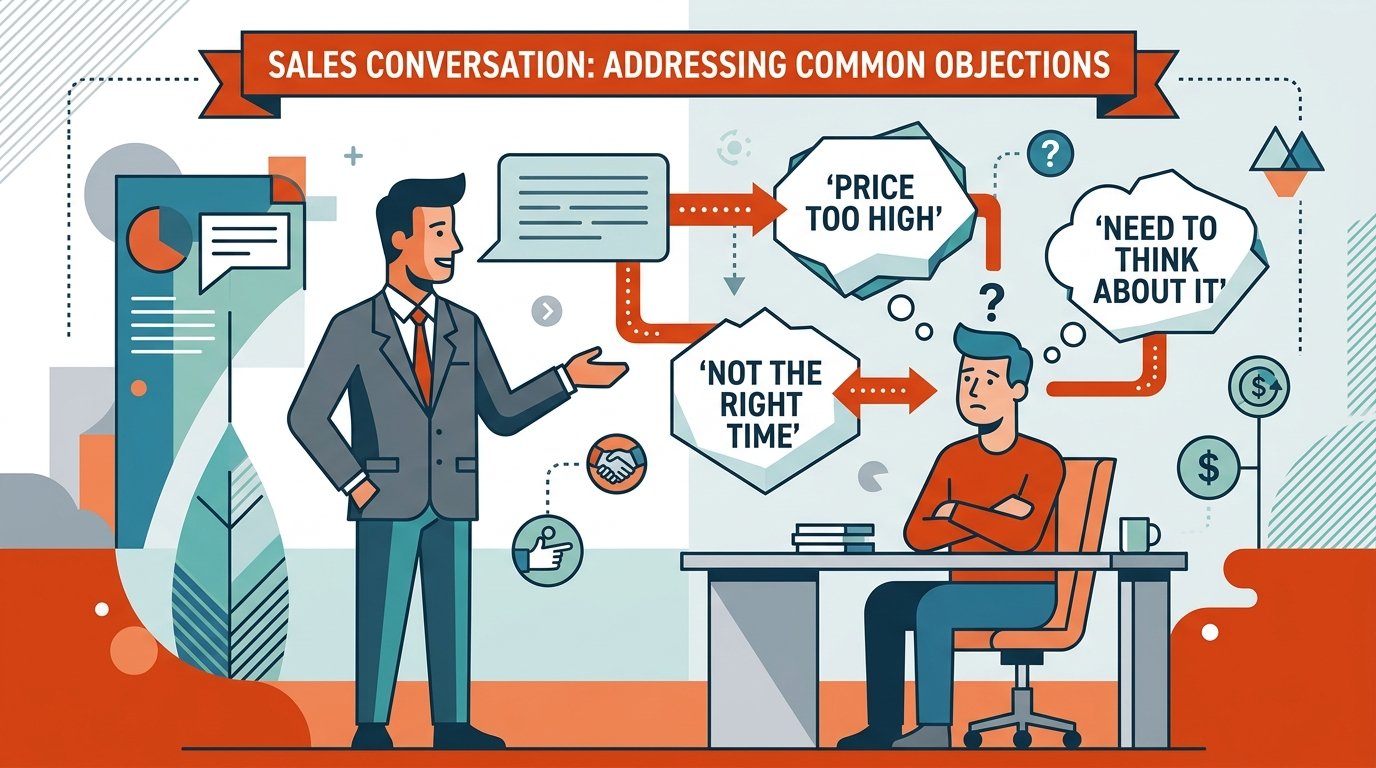
Sales objections are not an obstacle: they are a signal of interest. A customer who is not interested simply does not object —they disappear. When someone raises an objection, they are saying that they are still in the conversation and need more information or more confidence to move toward the sales closing.
Handling objections involves listening actively, understanding the real concern behind the words and responding with arguments that remove the perceived barrier. Resolving objections well is, in many cases, what makes the close possible. These are the most frequent ones and how to address them.
«It’s too expensive» (price objection)
It is the most universal objection. Often, when a customer says something is expensive, they are actually saying that they do not see enough value to justify the price. The response is not to lower the price immediately, but to reframe the conversation toward return on investment and concrete benefits before attempting the sales closing again.
Strategy: break down the cost in terms of real impact. If your service costs X per month but saves Y hours of work or prevents Z errors, the price stops being the protagonist. You can also offer a trial period or an entry-level plan that reduces the initial barrier.
«I need to think about it» (time objection)
This objection usually hides an unexpressed doubt. Before accepting it without question, ask with genuine curiosity: «Of course, is there any specific aspect you need more information on?». In many cases, the answer reveals the real objection —price, trust, internal authorization— that you can work on to resume the sales closing.
If the customer genuinely needs time, agree on a specific date to resume the conversation. A follow-up without a date is a lost opportunity.
«We already have a supplier» (competition objection)
Do not try to attack the current competitor. Instead, show curiosity: «What do you value most about your current supplier?». That answer tells you exactly what you need to match or surpass. Offering a no-cost trial or a comparative demonstration is an effective way to lower resistance without pressuring and to keep the possibility of a close alive.
«I don’t have the authority to decide» (decision-maker objection)
If your contact is not the one who makes the final decision, ask for access to the real decision-maker in a direct but respectful way: «Could I prepare an executive summary to present to the right person?». Facilitating that step —with clear and tailored materials— multiplies the chances of the sales closing reaching the right level.
«Now is not the right time» (urgency objection)
The customer perceives that they can wait without consequences. The most honest response is to quantify the cost of waiting: what do they lose or fail to gain each month they do not act? If there is a real reason to act now —an implementation window, an upcoming price change, an approaching peak season— communicate it clearly and without artifice so that the sales closing is not unnecessarily delayed.
Sales closing in digital and remote environments
Most of the classic literature on sales closing assumes a face-to-face context. However, today the majority of B2B closes happen in hybrid or fully remote environments: video calls, email chains, electronic signature platforms. The process is essentially the same, but execution requires specific adaptations.
In a closing video call, the absence of full body language makes it necessary to pay more attention to tone of voice and pauses. Sharing your screen to review the proposal in real time —rather than sending it beforehand and waiting— keeps control of the narrative and reduces distractions. Ending the call with a concrete next step in writing —sent by email right after hanging up— is a practice that reduces the post-meeting cooling rate.
The closing email deserves special attention. A good closing email is not a generic reminder: it recaps the agreed benefits, anticipates the most likely objection and proposes a concrete action with a date. Tools like HubSpot Sales, Pipedrive or Salesforce allow you to track whether the recipient has opened the email and how many times, which gives signals about their level of interest before following up.
Electronic signature —with platforms like DocuSign or Adobe Sign— eliminates the friction of the formal close and reduces the time between the «verbal yes» and the signed contract, which is one of the highest-risk moments for reversal.
What does closing deals ethically mean?
Sales closing has a bad reputation partly because for decades it was associated with pressure tactics, artificial urgency and psychological manipulation. The reality is that those tactics may work once, but they destroy trust and, with it, any possibility of a long-term relationship.
Closing ethically means that the deal genuinely benefits the customer, not just the salesperson. It implies being transparent about what the product or service can and cannot do, not creating false urgency and respecting the customer’s decision-making pace. An ethical sales closing is also the most sustainable in the long run.
Some principles of ethical closing worth keeping in mind:
- Honesty about limitations: if your solution does not perfectly fit the customer’s needs, say so. Sometimes, the best sales closing is acknowledging that you are not the right option at this moment.
- No manufactured urgency: scarcity or limited time are only valid arguments if they are real. Inventing them erodes credibility and compromises future closes.
- Listen before arguing: an ethical close starts from understanding what the customer needs, not from executing a script.
- After-sales as a commitment: the sales closing does not end with the signature. The subsequent follow-up is part of the agreement.
How to prepare the closing negotiation before the meeting?
The sales closing does not start at the moment of asking for the decision: it starts much earlier, in preparation. The more information you have about the customer —their needs, their usual objections, their decision-making process, their business priorities— the more effective your closing negotiation will be.
These are the key elements you should have ready before any sales closing meeting:
- Personalized value map: what specific benefits this particular customer gets, not the generic customer.
- Prepared responses to foreseeable objections: based on previous conversations or the sector profile.
- Proposal options: having two or three price or scope alternatives gives you flexibility to negotiate without conceding on what is essential and facilitates the close.
- Clarity about the decision-maker: knowing who signs and who influences the decision is fundamental to avoid closing with the wrong person.
- Defined next step: if the meeting does not end in a sales closing, what is the concrete next step? Never leave a meeting without a clear commitment.
What to do after the close? After-sales as part of the deal

Many salespeople make the mistake of disconnecting once the contract is signed. However, the period immediately following the sales closing is critical for consolidating the relationship and preventing cognitive dissonance —that feeling of doubt that sometimes appears after an important purchase.
Good after-sales follow-up reinforces that the customer made the right decision. This includes confirming the next steps clearly, offering support during implementation and being available to resolve questions in the first few weeks. According to Gartner data, customers who perceive high-quality after-sales support have a renewal probability between 30% and 40% higher than those who do not receive it, which makes follow-up a business lever as important as the close itself.
Moreover, the satisfied customer is the best source of new opportunities: referrals, renewals and contract expansions usually come from those who experienced a positive buying process from start to finish. The sales closing, well managed, is not the end of the cycle —it is the beginning of a commercial relationship that can last for years.
How to improve your sales team’s closing rate?
If you manage a commercial team in an SME, improving the sales closing does not depend solely on the individual skills of each salesperson. It depends on systems, processes and continuous training.
Some concrete levers for improving the closing rate at team level:
- Lost deal analysis: studying why deals are lost is as valuable as celebrating those that are won. Identify patterns in unresolved objections that prevent the sales closing.
- Role-playing and simulations: practicing closing situations in a safe environment allows the team to build confidence without the cost of losing a real opportunity.
- Shared playbook: documenting the most effective responses to the most frequent objections ensures that the team works from a solid foundation for the sales closing, not relying solely on each person’s intuition.
- CRM tracking: tools like HubSpot, Salesforce or Pipedrive allow you to centralize information on each prospect, identify at which stage of the process the most closing opportunities are lost and act on that specific stage. The CRM is not a passive record: it is the active map of your pipeline.
- Clear closing metrics: measuring the conversion rate by salesperson, by customer type and by channel allows decisions to be made based on data, not perceptions.
In short, sales closing is a discipline that can be learned, practiced and improved systematically. It is not an innate talent reserved for a few: it is the result of preparation, listening and the intelligent application of the right techniques at the right moment.
Frequently asked questions about sales closing
How many times should I attempt to close in the same meeting?
There is no fixed number, but the general rule is to attempt the sales closing when you detect clear buying signals, not mechanically. If the customer rejects the first attempt, listen to the objection, resolve it and try again when you have added more value. Forcing multiple attempts without resolving the real doubts creates unnecessary pressure and can damage the relationship.
What is the difference between a sales closing and a closing negotiation?
The sales closing is the moment when the customer makes the decision to buy. The closing negotiation is the prior process —sometimes brief, sometimes extensive— in which conditions, prices, timelines or scope are adjusted to reach an agreement that works for both parties. In complex or B2B sales, the closing negotiation can span several meetings.
Is it wrong to use urgency techniques in the close?
It depends on whether the urgency is real or manufactured. Communicating that a price changes on a specific date, that availability is limited or that there is an implementation window is perfectly legitimate if it is true. Inventing urgency to pressure the customer is a practice that erodes trust and usually generates buyer’s remorse, which ends up harming both the relationship and any future sales closing.
How do I close a sale without seeming pushy?
The key is for the sales closing to be the natural consequence of a conversation in which you have listened to the customer, understood their needs and demonstrated that your solution resolves them. When the prior process is solid, asking for the decision does not seem pushy: it seems like the logical step. If you feel you have to «push» a lot, it is a sign that there are unresolved objections remaining.