
A memorandum —also called a memo— is an essential tool within the internal communication of any organization. This document allows information to be conveyed clearly and concisely, ensuring that all members of a team are aware of important matters. According to the Panhispanic Dictionary of Doubts of the RAE, memorando is the preferred form in Spanish to refer to the report in which facts and reasons that must be taken into account in a given matter are compiled, with memorándum being its equally valid Latinized variant.
Contenidos
In the business environment, the memorandum has remained a formal document that, although it has evolved with the arrival of email and corporate intranets, continues to be indispensable for certain communications. Below you will find everything you need to know: its definition, structure, types, mistakes to avoid, real examples and a ready-to-use template.
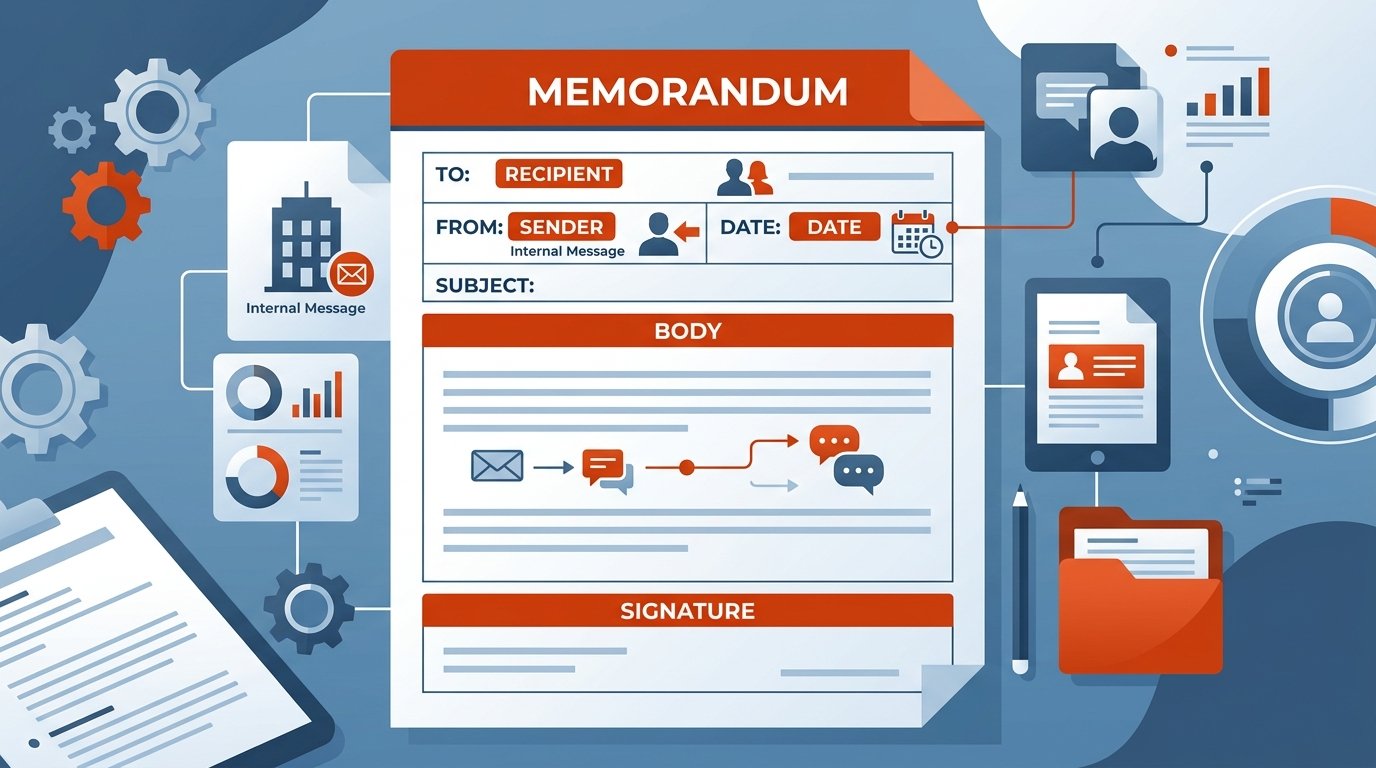
What is a memorandum?
A memorandum is a brief, official written document used within an organization to make requests, issue reminders, give instructions or communicate relevant information. Its formal nature gives it particular weight in internal communication, as it is considered an official record that can be consulted in the future.
This type of document can address a variety of topics, from policy changes to reminders about important events. What distinguishes a memorandum from a simple email is precisely its documentary value: once issued, it is usually filed and becomes part of the institutional memory of the company.
Furthermore, the memorandum can be used to document decisions, agreements and other relevant aspects. This helps create a company record that can be consulted in the future, and can even acquire evidentiary value in audits or internal administrative processes.
In terms of length, a standard memorandum should not exceed one page (between 150 and 300 words). If the content requires further development, the appropriate document is probably a report. Brevity is not a limitation, but a defining characteristic of the format: it forces the writer to prioritize information and communicate with precision.
How does a memorandum work in internal communication?
The memorandum acts as an effective communication channel within a company. Unlike an email, which can easily get lost in an inbox, the memorandum has a standardized format that ensures information is presented clearly and formally.
The impact of the memorandum on internal communication is reflected in several areas:
- Clarity: Its structure helps information to be understood quickly.
- Formality: It establishes a serious tone that emphasizes the importance of the message.
- Record: It allows communication to be documented, which can be useful in the future.
- Reach: It is usually addressed to many people at once, representing the interests of the company as a whole.
Furthermore, the use of memorandums can help reduce confusion and misunderstandings among employees, ensuring that everyone receives the same information at the same time. In the digital age, many organizations send their memorandums by email or publish them on intranets, but maintain the structured format that defines them as an official document.
What are the parts of a memorandum?
A well-structured memorandum consists of several fundamental parts that ensure its effectiveness:
- Header: Includes the organization’s letterhead, internal numbering, sender information, recipient, date and subject.
- Introduction: Presents the purpose of the memorandum briefly and directly.
- Body: Details the information to be communicated. The message should be brief and precise, with paragraphs of no more than four to six lines.
- Conclusion: May include a call to action or an invitation to discuss the content.
- Signature and footer: The sender’s signature, their position and, if applicable, the company seal are added to validate the document.
Clarity in the presentation of these parts is essential for the memorandum to fulfill its function. Each section should be easily identifiable and contain relevant information. According to Asana, a well-written subject line in the header is key: “it lets people know what it is about before opening it and helps them prioritize their reading”.
What types of memorandum exist and when should each be used?
There are several types of memorandum, each with a specific purpose. Knowing the right type is key to improving corporate communication and ensuring that information reaches its audience effectively:
- Informational: Used to communicate relevant information to all employees or to a specific department.
- Clarification: Seeks to clarify doubts about a specific topic already addressed in a previous meeting or communication.
- Reminder: Notifies about upcoming events, deadlines or important dates.
- Proposal: Presents ideas, changes or initiatives to be implemented that require approval or discussion.
Memorandum vs. other internal documents: when to use each one?
A frequent question in companies is knowing when it is appropriate to write a memorandum and when another type of document is more suitable. The following comparison will help you choose the correct format:
- Memorandum: Brief and formal internal communication, addressed to one or more recipients within the same organization. Ideal for instructions, reminders, policy changes or proposals. No response is required and it is filed as an official record.
- Circular: Similar to the memorandum, but its recipient is always collective (the entire staff or a complete department). Used for general announcements such as schedule changes or safety regulations. Unlike the memorandum, it is usually not individually numbered.
- Minutes: A document that records the agreements and proceedings of a meeting. While the memorandum anticipates or instructs, the minutes record what has already occurred. They require the approval of those in attendance.
- Report: A more extensive and analytical document that develops a topic with data, conclusions and recommendations. Used when the matter requires in-depth analysis, not just quick communication. If you need to know more, consult our guide on how to write a report.
The practical rule is simple: if you need to communicate something quickly, formally and in a way that leaves a record, the memorandum is your tool. If you need to analyze, use the report; if you need to keep a record of a meeting, use the minutes.
The memorandum in Spain and Latin America: differences in use
Although the memorandum is a universal document in the Spanish-speaking world, its use and terminology present nuances depending on the geographical and administrative context that are worth knowing.
In Spain, the most widely used term in the private business sector is memorando or simply nota interna (internal note). In the Spanish public administration, this type of communication is usually channeled through internal official letters or internal administrative notes, although the memorandum format is applied de facto. The National Institute of Public Administration (INAP) recognizes the memorandum as part of the internal communication instruments in public organizations.
In Latin America, the memorandum has a much more prominent presence in public administration and the corporate world. In countries such as Colombia, Peru, Mexico or Venezuela, the term memorando (or memorándum) is in everyday use and is regulated in the document management manuals of state bodies. In many of these contexts, the memorandum has the status of an official document with mandatory numbering, the issuer’s signature and filing in the institutional record. In Colombia, for example, the ICONTEC technical standard for commercial documents (GTC 185) establishes specific guidelines for its drafting and format.
The most practical difference: in Spain the formality of the memorandum is high but flexible; in much of Latin America, its protocol is stricter and non-compliance can invalidate the communication for administrative purposes.
The memorandum in digital environments: email, intranets and electronic signatures
The emergence of tools such as Slack, Microsoft Teams or corporate intranets has raised a legitimate question: does the memorandum still make sense in an environment where everything is communicated in real time? The answer is yes, but with nuances.
The key distinction lies in the level of formality and purpose: the memorandum is reserved for official announcements, policy changes or directives that require a permanent record, while email and messaging tools are ideal for daily and dynamic communication.
Some guidelines for adapting the memorandum to the digital environment:
- Corporate email: You can send the memorandum as a PDF attachment, keeping its formal structure intact. The email subject line should reproduce the memorandum’s subject to facilitate later searching.
- Intranet or corporate portal: Publishing the memorandum in a centralized space ensures that all recipients access the same version. Asana notes that sending an electronic memorandum to groups of employees is beneficial because “it gives them a centralized point where they can view company information”.
- Slack or Teams: These platforms are suitable for informal or follow-up communications, but they do not replace the memorandum when the communication needs to be archived as an official record. In that case, the message in the channel can be accompanied by the attached document.
- Mobile accessibility: If you distribute the memorandum in digital format, make sure it is readable from a smartphone. PDF is the most recommended format for its universal compatibility.
The golden rule in digital environments: use the informal channel to notify, but the formal memorandum to leave a record. A Teams message that says “I’m attaching the memo about the new protocol” is perfectly valid; what cannot be missing is the structured document behind it.
Validity of the digital signature on the electronic memorandum
When the memorandum is distributed in digital format, a practical question arises: is the electronic signature valid as a substitute for the handwritten signature? In the European context, the eIDAS Regulation (EU) 910/2014 establishes the legal framework for electronic signatures and grants them full legal validity, equating them to handwritten signatures provided that a qualified electronic signature is used. This means that a memorandum signed digitally with a recognized certificate has the same evidentiary value as one signed on paper.
In Latin America, the regulation varies by country, but the trend is convergent: Mexico has the Advanced Electronic Signature (FIEL/e.firma), Colombia regulates the digital signature through Law 527 of 1999 and its regulatory decree, and Peru has Law 27269 on Digital Signatures and Certificates. Under all these frameworks, the electronic memorandum with a certified digital signature has official validity before public bodies and in administrative proceedings. If your organization manages memorandums with legal or contractual consequences, it is advisable to verify with the legal department what level of electronic signature is required in each case.
Tone and linguistic register: recommended phrases and expressions to avoid
One of the aspects that raises the most doubts when drafting a memorandum is tone. Knowing that it should be “formal” is not always enough: the line between appropriate formality and excessive rigidity —or between approachability and inappropriate informality— can be blurry. The following concrete examples will help you calibrate the correct register.
Recommended phrases for the memorandum
- “By means of this document, all staff are hereby informed that…” — Standard opening, clear and neutral.
- “Area managers are reminded that the submission deadline expires on…” — Direct reminder without an unnecessarily punitive tone.
- “The [name] Department proposes the implementation of…” — Appropriate opening for proposal memorandums.
- “For any queries, please contact [name or department] before [date].” — Closing with a precise call to action.
- “The collaboration and punctuality of all teams is appreciated.” — Courteous closing that does not diminish formality.
- “I remain available to provide any further information deemed necessary.” — Useful closing formula for proposal or clarification memorandums.
Expressions to avoid
- “Hi everyone, just wanted to let you know that…” — Informal opening typical of everyday email, not an official document.
- “As you all know…” — Presupposes knowledge and reduces clarity; the memorandum should be self-explanatory.
- “URGENT!!” or the use of emojis — These break the required formality and can undermine the authority of the message.
- “I hope this is clear” — Condescending tone that can create unnecessary tension.
- “I’m sending you this memo to…” — The informal first person is appropriate in messaging, not in an archivable document.
- “Subject: Information” or “Subject: Meeting” — Vague subjects that do not allow the reader to prioritize reading or retrieve the document from the archive.
The key is to write as if the document were going to be read by someone who does not know you and who, moreover, might consult it months later. The memorandum speaks on behalf of the organization, not the person who signs it.
3 complete memorandum examples
Below you will find three memorandum models, fully drafted and ready to adapt to your company. Each one responds to a different type of internal communication.
Example 1: Informational memorandum (policy change)
This model is used to communicate a change in the organization’s internal rules or procedures.
- TO: All company staff
- FROM: Human Resources Department
- DATE: [Date of issue]
- SUBJECT: Update to the hybrid work policy — Memorandum No. 012
By means of this document, all staff are informed that, as of next month, the hybrid work policy is updated as follows: up to three remote working days per week will be permitted, subject to prior coordination with the head of each department. Mandatory in-office days will be Tuesdays and Thursdays.
For any queries, please contact the Human Resources department before [deadline].
Sincerely,[Full name]Head of Human Resources[Company name]
Example 2: Reminder memorandum (submission deadline)
This model is useful when a deadline is approaching and it is necessary to remind the teams involved.
- TO: Department heads
- FROM: Administration and Finance Department
- DATE: [Date of issue]
- SUBJECT: Reminder — Submission of quarterly reports — Memorandum No. 027
All area managers are reminded that the reports corresponding to the first quarter of the fiscal year must be submitted before the 30th of this month. Late submission will affect the internal audit schedule and cannot be accepted unless a justified reason is communicated in advance.
The punctuality and cooperation of all teams is appreciated.
Sincerely,[Full name]Head of Administration and Finance[Company name]
Example 3: Proposal memorandum (new initiative)
This model is used to present an idea or project that requires evaluation or approval from management.
- TO: Management Committee
- FROM: Marketing Department
- DATE: [Date of issue]
- SUBJECT: Proposal for an internal digital communication training program — Memorandum No. 035
By means of this memorandum, the Marketing Department proposes the implementation of a quarterly internal training program on digital communication tools. The objective is to improve efficiency in content management and coordination between departments.
An executive summary with the objectives, proposed timeline and estimated budget is attached. We request that the Management Committee evaluate the proposal at the next regular meeting.
Sincerely,[Full name]Marketing Manager[Company name]
Free memorandum template: ready to fill in
If you need to draft a memorandum immediately, you can use the following template as a starting point. Copy it, adapt the fields to your company and you will have a document ready in minutes.
- Letterhead: [Company name and logo]
- MEMORANDUM No.: [Internal sequential number]
- TO: [Recipient’s name or department]
- FROM: [Sender’s name and position]
- DATE: [Day, month and year]
- SUBJECT: [Brief description of the topic — maximum 8 words]
[Introductory paragraph: explain the reason for the memorandum in 2-3 lines.]
[Body: develop the necessary information clearly and directly. Use short paragraphs of 4-6 lines. If there are instructions or specific points, use a numbered list.]
[Conclusion or call to action: indicate what recipients should do, if applicable, and by what date.]
Sincerely,[Full name][Position][Department][Signature and seal, if applicable]
Do you prefer to work directly in your word processor? You can copy this structure into Google Docs or Microsoft Word: paste the text, replace the fields in brackets with the actual data and add your company logo in the header to give it greater formality. If you use Word, save it as a template (.dotx) to reuse it without having to reformat it each time.
How to write a memorandum in 4 steps?
Drafting a memorandum may seem complicated, but by following these four steps you can create an effective document:
- Define the purpose: Before you start, make sure you are clear about the reason for the memorandum. Are you informing, reminding or proposing something?
- Structure the content: Organize the information into the parts we have described: header, introduction, body and conclusion.
- Draft the message: Use clear and direct language, avoiding unnecessary jargon. The tone should be formal but understandable to all recipients.
- Review before sending: Make sure there are no errors and that the information is accurate. An error-free memorandum reinforces the sender’s credibility.
This simplified approach will help you create a memorandum that fulfills its purpose and is easy to understand. Attention to detail is key to making the document truly effective.
Common mistakes when drafting a memorandum
Knowing the most common mistakes is just as useful as knowing the correct structure. These are the errors that appear most frequently and that, in many cases, reduce the validity or effectiveness of the document:
- Vague or generic subject line: Writing “Subject: Information” or “Subject: Meeting” says nothing. The subject must be specific and self-explanatory: whoever reads it must understand the content without opening the body of the document.
- Informal or colloquial tone: The memorandum is an official document. Expressions such as “hi everyone,” “just wanted to let you know” or the use of emojis break the required formality and can undermine the authority of the message.
- Absence of numbering: Failing to assign a sequential number to the memorandum makes it difficult to file, trace and subsequently locate. In administrative contexts, a memorandum without a number may lack formal validity.
- Excessively long body: The memorandum is not a report. If the development exceeds three or four paragraphs, the appropriate document is probably a different one. A lengthy body dilutes the message and reduces the likelihood that the recipient will read it in full.
- Omitting the call to action: If the memorandum requires a response or action from the recipient, this must be stated explicitly, including a deadline. Leaving it implicit creates ambiguity and delays.
Reviewing these five points before sending any memorandum is a simple practice that notably improves the quality and effectiveness of internal communication.
Tips for writing an effective memorandum
To make your memorandum truly effective, consider these tips:
- Keep it brief: Avoid including unnecessary information that distracts from the main message.
- Use clear language: Make sure all employees understand the content, regardless of their area.
- Check grammar and spelling: An error-free document reinforces credibility.
- Include a call to action: If necessary, indicate what steps recipients should take and by what date.
- Number your memorandums: Keeping a sequential numbering system facilitates filing and the traceability of internal communications.
By following these tips, you can ensure that your memorandum is effective and fulfills its objective of informing and coordinating within the organization. If you want to explore other types of business documents, at Narratias you will find specific guides for each format.